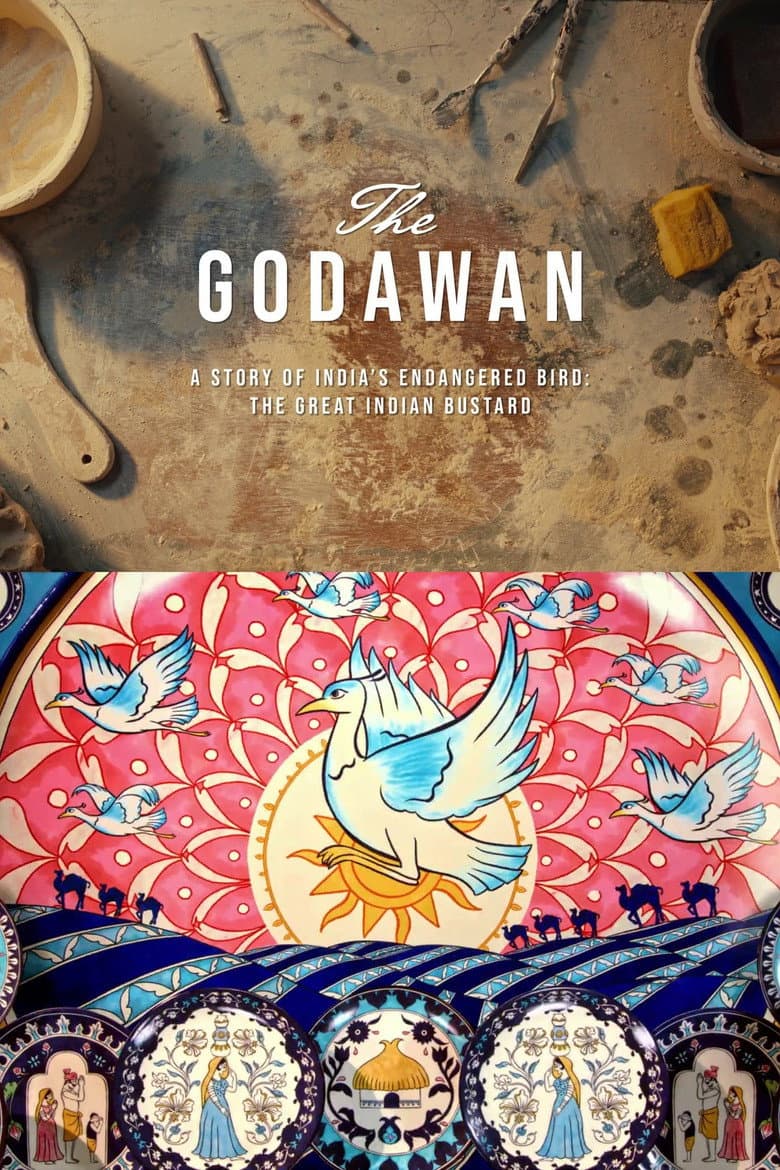
There are no dinosaurs in Suresh Eriyat's new film. There is something rarer, and more precarious: a bird on the edge of vanishing. The Godawan, released on October 4, 2026, runs just four minutes, yet in that short span it performs a kind of resurrection. The title refers to the great Indian Bustard, a creature so critically endangered that its remaining population could fit into a single jeep. Eriyat, a veteran of Indian animation known for a distinctive handcrafted sensibility, has chosen to bring this bird back not through documentary footage or CGI, but through stop motion and blue pottery - an unlikely marriage that turns out to be inspired.
The film is listed under Animation, with Hindi as its original language, produced within Bollywood. Its cast is unknown, which makes sense for a work that relies on objects rather than voices. The great Indian Bustard, or godawan as it is known in Rajasthan, once ranged across the grasslands of the subcontinent. Today, it survives in fragments of habitat, threatened by power lines, hunting and the slow disappearance of its open terrain. To animate such a bird is to confront absence itself. Eriyat appears to have understood this instinctively. Rather than simulate life, he has assembled it from clay, glaze and fire.
Blue pottery is a craft with its own history of near-erasure. Associated with Jaipur, it draws on techniques that traveled from Persia and Central Asia and were absorbed into local workshops centuries ago. The palette is limited - cobalt on white, occasionally touched with turquoise or green - and the process is unforgiving. Each piece is shaped, dried, painted and fired, and every stage invites failure. Stop motion multiplies that risk. A single second of footage can demand twenty-four separate manipulations of a fragile ceramic object. A four-minute film could mean years of production compressed into a sliver of screen time. That ratio - immense labor, brief result - mirrors something about conservation itself. The godawan's recovery, if it comes, will be measured in decades; the film that mourns it lasts about as long as a coffee break. The disproportion feels deliberate.
What does resurrection mean here? The word appears in the film's official overview, and it isn't casual. The godawan is not extinct, but it hovers in that liminal zone where extinction becomes a matter of arithmetic. To resurrect is to insist that something presumed finished still has a claim on the present. Eriyat's ceramics do not pretend to be alive. They are fired earth, painted and posed, and their stillness is part of the point. When a clay bird turns its head frame by frame, the movement is both magical and elegiac - we are watching craft imitate biology, and we are watching a species that may not survive the century. The material itself carries the message: fragile, beautiful, dependent on human hands to endure.
It is worth noting what The Godawan is not. It is not a nature documentary, not a public service announcement, not a feature-length narrative with celebrity voices. Its four-minute runtime places it in a tradition of short animation that Indian studios have often treated as a calling card rather than a destination. Eriyat has spent years in that tradition, building a reputation for work that values texture over spectacle. Here, the texture is literal. Blue pottery's surfaces catch light in ways that digital rendering rarely manages, and the film's Hindi-language framing keeps it rooted in the landscape it depicts. This is a Bollywood animation in the sense that it emerges from the Hindi film industry, but it operates at a scale that industry rarely attempts. No songs, no stars, no intermission. Just clay, a camera, and a bird running out of time.
The film's timing matters too. October 2026 finds conservationists still fighting for the godawan's grasslands, still arguing over breeding programs and power-line diverters. A four-minute stop-motion film will not settle those debates. But it can do something else: it can make the bird visible in a culture that has largely forgotten it. For most viewers, the godawan is an abstraction, a statistic in a wildlife report. In Eriyat's hands, it becomes a ceramic object with weight and shadow, something you could almost hold. That intimacy is the film's quiet achievement. Animation has always been a medium of transformation, and here the transformation runs both ways: a vanishing species becomes art, and art becomes an argument for keeping the original alive. Whether The Godawan reaches a wide audience remains to be seen. But it has already done what resurrection stories are supposed to do. It has made us look again at something we were prepared to lose.