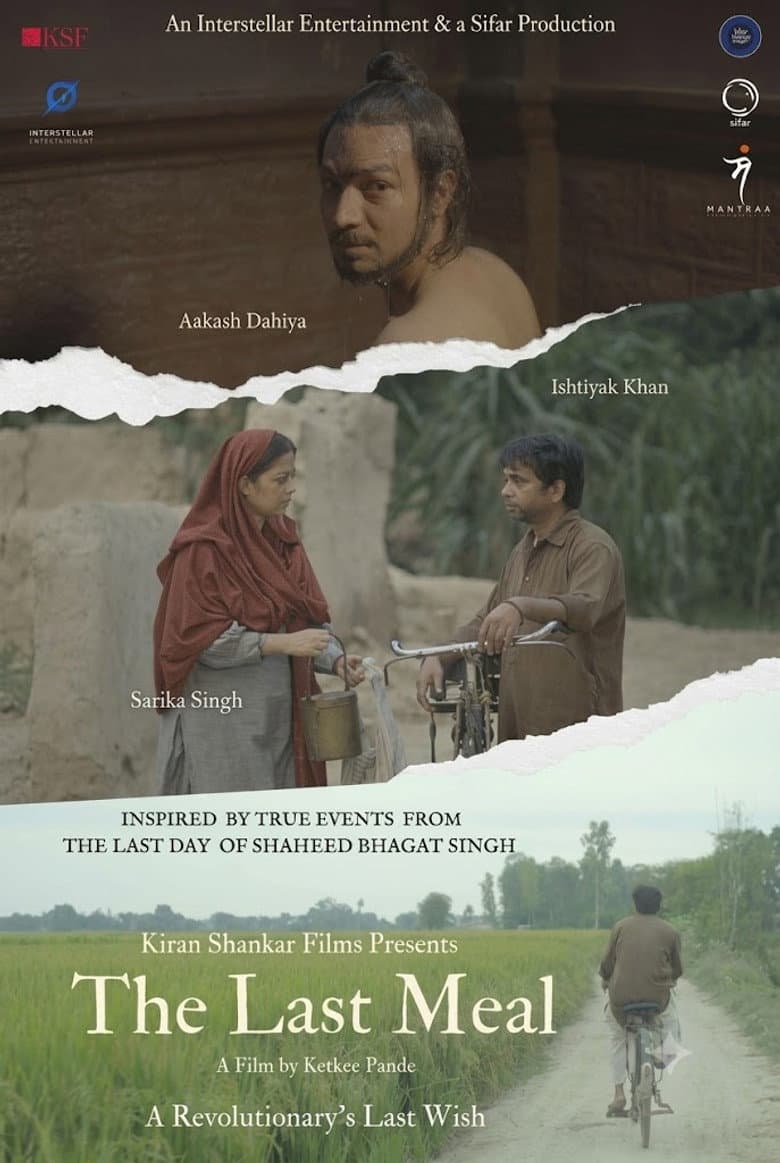
There is a moment in the new short film The Last Meal where a man with nothing left to give is asked what he wants to eat before he dies. It is March 1931, and the man is Bhagat Singh. The British Raj has sentenced him to hang, and the officers at Lahore Jail expect a routine request - perhaps something hearty, perhaps something nostalgic. What they receive instead is a name. Bhagat Singh does not ask for food; he asks for Bhoga, a sweeper at the prison, to prepare his final meal.
This is the premise of Ketkee Pande's 28-minute film, released on September 28, 2026. It belongs to a tradition of Indian cinema that uses historical figures not as monuments but as mirrors. The Last Meal, classified as a drama with strong family undertones, is less interested in the spectacle of martyrdom than in the quiet mechanics of dignity. The film is in Hindi, produced within the Bollywood industry, and it runs barely longer than a single television episode. Yet in that brief span, Pande attempts to untangle one of the most stubborn knots in Indian social life: untouchability.
Aakash Dahiya plays Bhagat Singh not as the fiery revolutionary of popular imagination but as a man in his final hours, deliberate and tired. The request itself is the film's engine. By asking for Bhoga, Bhagat Singh forces a confrontation that the jail's administrative machinery is entirely unprepared for. The British officers see it as an eccentricity; the Indian staff see it as a rupture. Bhoga, portrayed by Ishtiyak Khan, is a man accustomed to being invisible. His caste has assigned him the task of cleaning spaces no one else will touch. Preparing food for a political prisoner - a prisoner of Bhagat Singh's stature - is a task that no one in the jail's hierarchy can easily process.
The supporting cast fills out the claustrophobic world of the prison. Sarika Singh appears as Raano, a character whose presence suggests the domestic sphere that Bhagat Singh has left behind. Paritosh Sand plays a lawyer, likely part of the legal machinery that has already sealed the protagonist's fate. Jagdish Rajpurohit is credited as Shyam, a milk man, while Rajinder Sharma Nanu plays the Jailor and Justin Nisly appears as a British Officer. These figures orbit the central relationship between Bhagat Singh and Bhoga, each representing a different facet of the colonial and social order that the film interrogates.
What makes The Last Meal worth noting is its refusal to turn Bhoga into a symbol. He is not a saintly victim; he is a man with trembling hands and a lifetime of internalized deference. The stigma of untouchability is not something he can shed simply because a famous revolutionary has summoned him. Pande's direction seems to understand that dignity is not granted by a single gesture, no matter how noble. It is negotiated, slowly and unevenly, in the space between two people who have been taught to see each other through the lens of hierarchy.
The film's runtime of 28 minutes is a deliberate choice. It does not allow for subplots or historical exposition. Instead, it focuses on the preparation of a meal - the selection of ingredients, the act of cooking, the moment of serving. These mundane details become charged with meaning. Who is allowed to touch the food? Who is allowed to serve it? Who is allowed to eat it? The Last Meal suggests that the answers to these questions are not just matters of etiquette but of politics.
Family, as a genre descriptor, may seem out of place in a film about a prison and a hanging. But The Last Meal understands that the family is where caste is first taught and where it is most intimately enforced. Raano's presence, however brief, hints at the domestic life that Bhoga has never been allowed to fully inhabit. The film does not offer easy resolutions. It does not pretend that one meal can undo centuries of oppression. What it offers instead is a portrait of a small, radical act - and the man who was brave enough to request it and the man who was brave enough to fulfill it.
The TMDb rating currently stands at 0/10, based on no user votes, which is typical for a film that has just been released and has not yet found its audience. That number is meaningless for now. What matters is whether The Last Meal manages to do what its title promises: to make us think about what we owe each other in the final moments of a life, and what we have been taught to withhold.