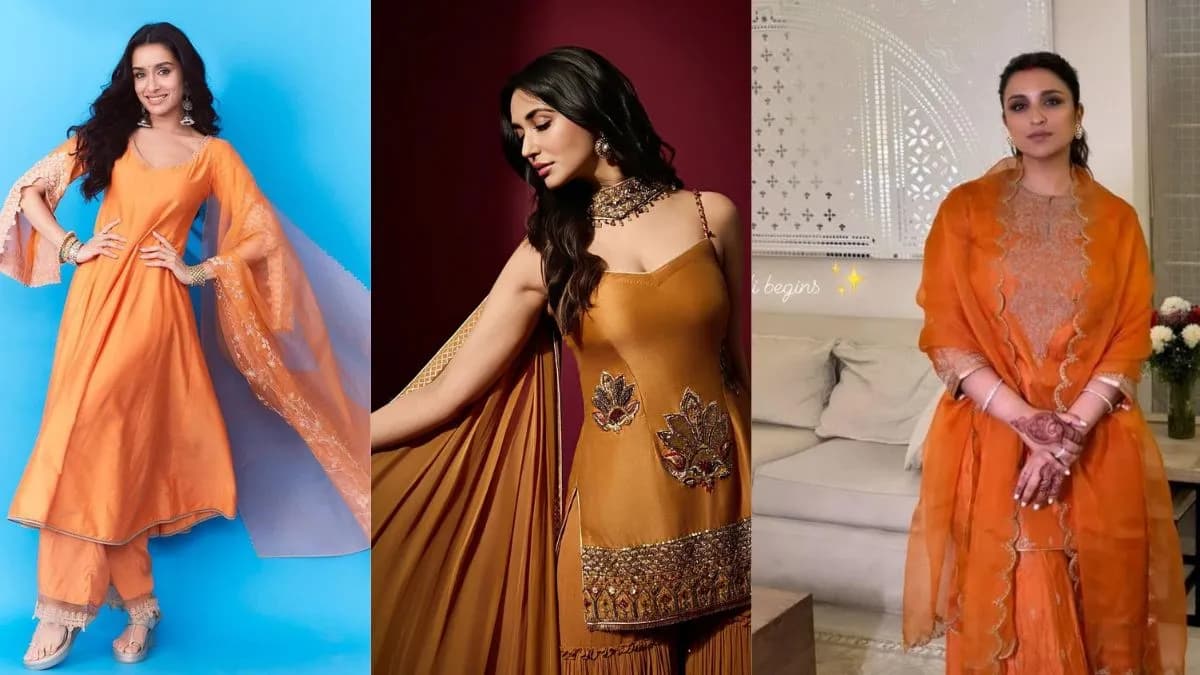
Navratri 2026 has officially begun, and the first night belongs to orange - a colour that has long been a staple of the festival's nine-day wardrobe. From bright saffron lehengas to burnt-orange kurta sets, Bollywood's most photographed women have turned the shade into a reliable festive formula, and this year's celebrations are already drawing on their best-documented outings. As garba and dandiya nights return across the country, the opening day's colour code offers the easiest entry point for anyone building a Navratri look, and the industry's celebrity stylists have spent years refining exactly how to wear it.
Orange works for Navratri for reasons that have little to do with trend cycles. The shade sits at the warmer end of the spectrum associated with the festival's first day, and it flatters a wide range of skin tones when the undertone is chosen carefully. More practically, it photographs well under the mixed lighting of a community hall or an open courtyard, which is why so many celebrity Navratri appearances - and the festive campaign shoots that follow them - lean on it. The colour also pairs easily with the gold and mirror work that defines most traditional Gujarati silhouettes, allowing an outfit to read as festive without becoming a costume.
Five Celebrity Directions Worth Revisiting
The most reliable reference point remains the classic orange lehenga, the kind that appears in countless celebrity festive posts each season. A flared skirt in a saturated orange, paired with a contrasting blouse and a lightly embellished dupatta, is the look most often associated with leading actresses during Navratri. The formula has stayed popular because it is forgiving: the volume of the skirt does the work, and the blouse can be as simple or as ornate as the wearer wants. For day one, a heavier border on the dupatta is usually enough to signal occasion.
A second, more contemporary route is the orange kurta set. Several celebrities have favoured straight-cut kurtas in burnt or rust orange, worn with palazzo pants and a printed dupatta. This is the practical choice for anyone who plans to actually dance - the silhouette allows movement, and the colour still reads as traditional. The trick, as stylists repeat, is in the fabric: a lightweight cotton or chanderi keeps the outfit from feeling heavy through a long evening, while a silk blend adds sheen for those who want it.
The third direction is the orange anarkali, a silhouette that has quietly become a festive mainstay. Floor-length anarkalis in orange, often with gold thread work at the yoke, offer the drama of a lehenga with the ease of a dress. Celebrity appearances in these outfits tend to keep the jewellery minimal - a single statement earring rather than a full set - precisely because the volume of the garment already provides the visual interest.
Sharara and gharara sets make up a fourth option, and they have grown more visible in recent festive seasons. An orange sharara with a short kurti reads younger and more playful than a lehenga, and it has become a favourite for celebrity appearances at garba events. The wide-legged silhouette is also more comfortable than it looks, which matters when the dancing starts.
Finally, there is the sari - the most underrated of the five. An orange sari, whether in georgette, organza or a traditional silk, can be styled for Navratri with a contrast blouse and a simple belt. It is the least fussy option for anyone who wants to look dressed up without committing to a full heavy ensemble, and it has the advantage of being wearable well beyond the festival.
Styling Notes That Keep Orange From Overwhelming
The most common mistake with orange is treating it as a single colour rather than a family. Saffron, tangerine, rust and burnt orange all behave differently, and the right one depends on the rest of the outfit. A saturated saffron tends to look best with gold and cream, while a deeper rust pairs naturally with earthy greens and browns. Mixing two oranges in one look is possible, but it needs a deliberate contrast in tone - a bright dupatta against a muted kurta, for instance - otherwise the outfit flattens out.
Jewellery choices follow the same logic. Oxidised silver works well with the earthier oranges and is often the more modern choice; traditional gold suits the brighter, more ceremonial shades. Heavy jhumkas and a maang tikka can be worn together for a wedding-adjacent look, but for garba nights a single pair of statement earrings is usually the better call, particularly if the outfit already has significant embroidery.
Footwear and hair are the details that separate a styled look from a dressed-up one. Flat mojaris or embellished sandals are the practical choice for dancing, and a braid or a low bun keeps the focus on the neckline and dupatta without competing with it. For those wearing a sari, a neatly pinned pallu is non-negotiable if the plan involves any movement at all.
The broader takeaway from this year's opening day is that the orange look does not require a new wardrobe. Most of the five directions above can be assembled from pieces already in circulation, which is part of why the shade keeps returning every Navratri. Day one sets the tone for the eight nights that follow, and starting with a colour that flatters almost everyone is a low-risk way to begin. For those still deciding, the celebrity playbook is straightforward: pick a silhouette that suits the evening's plans, keep the styling deliberate, and let the orange do the rest.
Source: Filmibeat