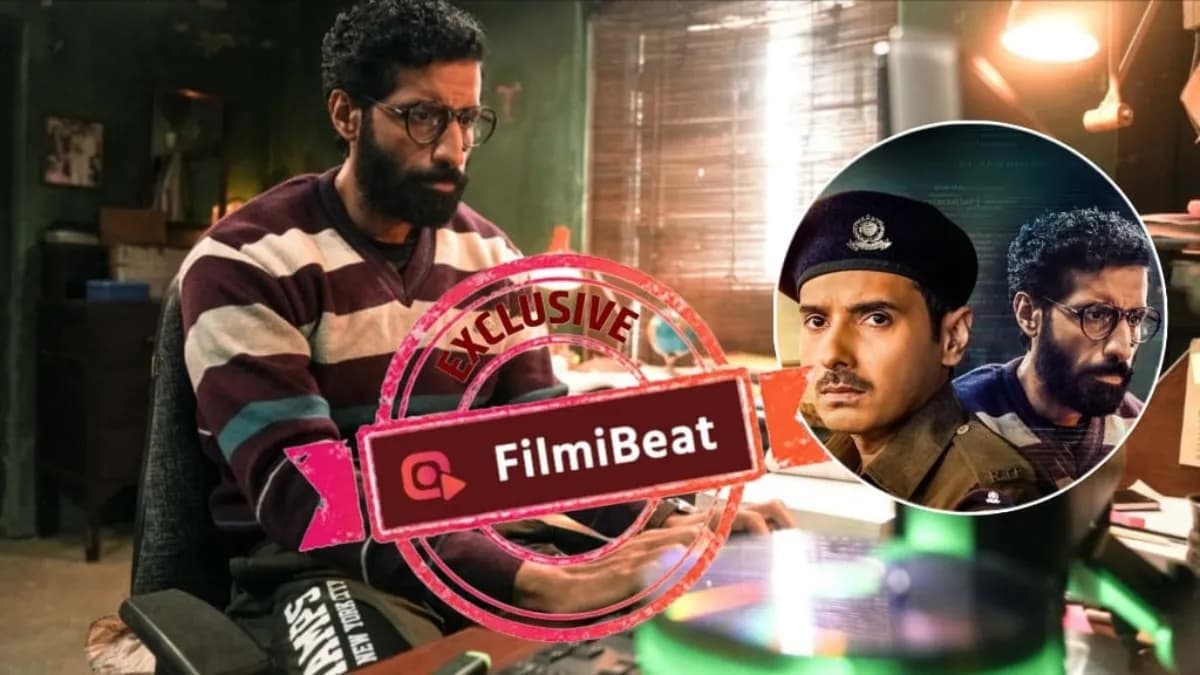
Bhuvan Arora is not the first actor to discover that a small role can change everything. But he may be one of the few willing to admit how much of that change arrived without warning. In an exclusive conversation, the actor opened up about his latest project, the character Afroz, and the strange, slow-burning satisfaction of playing a man who is still waiting for his life to begin. He also reflected on what it took to move past Firoz, the unforgettable gunrunner from "Farzi," and on the unlikely friendship that has grown between him and Divyenndu.
Arora is clear that Afroz and Firoz share almost nothing beyond the actor's face. "The two men only have my voice in common," Arora said. "This character does not walk into a room and own it. He enters quietly and hopes nobody asks him to leave." He described the role as a study in patience, both for the man on screen and for the actor playing him. Where Firoz was all sharp edges and sudden violence, Afroz carries a different kind of burden: the weight of unfinished sentences, delayed ambitions, and a life that keeps getting postponed.
The actor said the shift required him to unlearn many of the habits he had built while working on "Farzi." He called those months "a masterclass in stillness," explaining that the new part demanded he resist the urge to fill every pause. "My instinct is to do something with my hands, my eyes, my shoulders," he said. "Afroz doesn't do anything in a hurry. That was the hardest part. I had to trust that the silence would read on camera."
Finding the Rhythm of a Different Man
Arora spent weeks observing how people behave when they think no one is watching. He watched commuters on local trains, office workers on smoke breaks, and shopkeepers waiting for customers who might never come. He found a particular quality in those moments. "That waiting is its own language," he said. "It is not empty. It is full of calculations, small disappointments, and tiny hopes that the day might turn around." He used that observation to build Afroz from the inside out, rather than starting with an accent or a costume.
The actor also spoke about the discipline of not trying to make the audience like his character. He said that with Afroz, he had to accept that the audience might not root for him immediately. "That is fine," he said. "Some people earn your attention slowly. That is more honest to me than a grand entrance."
A Bond Built on Set, Not Just in Scenes
The conversation turned warmer when Arora was asked about Divyenndu, his co-star and, by all accounts, his friend. The actor said the friendship was not produced by a script or a marketing plan. It grew out of long, ordinary days between takes. "We would sit around and talk about nothing," Arora recalled. "Films, food, bad auditions, how tired we were. By the end, I could tell when he was about to crack a joke just from the way he shifted in his chair."
He said that comfort made its way into their scenes without either actor forcing it. "Trust does not need dialogue," Arora observed. "You just know the other person will catch you if the scene slips. That happened a lot. Not because we planned it, but because we were paying attention." He declined to reveal plot details but described the on-screen dynamic as "two people who keep missing each other, even when they are standing in the same room."
Beyond the Comparisons
Arora knows that audiences will inevitably compare Afroz to Firoz, and he does not dismiss that expectation. Instead, he frames it as a compliment to the earlier work. "If people remember Firoz, that means he stayed with them," he said. "But I can't play Afroz as Firoz. That would be a disservice to both men." He compared acting to a series of doors, each one closing behind you as you walk through the next. "You carry the experience. You don't carry the character. The character belongs to the story."
He also spoke about the pressure that follows a breakout role. "People expect you to repeat the thing they loved," he said. "But repetition is not growth. It is just a photocopy." He admitted that saying no to similar parts has cost him work, though he did not elaborate on which projects he turned down. "I would rather be quiet and honest than loud and wrong," he added.
Arora would not confirm a release timeline or any other production details, saying only that he is proud of the work and eager for audiences to meet Afroz on his own terms. For now, he seems content to let the character exist in that in-between space, waiting for viewers the way Afroz waits for his own life to begin. "I don't need everyone to understand him in the first ten minutes," Arora said. "I just need them to stay curious."
Source: Filmibeat