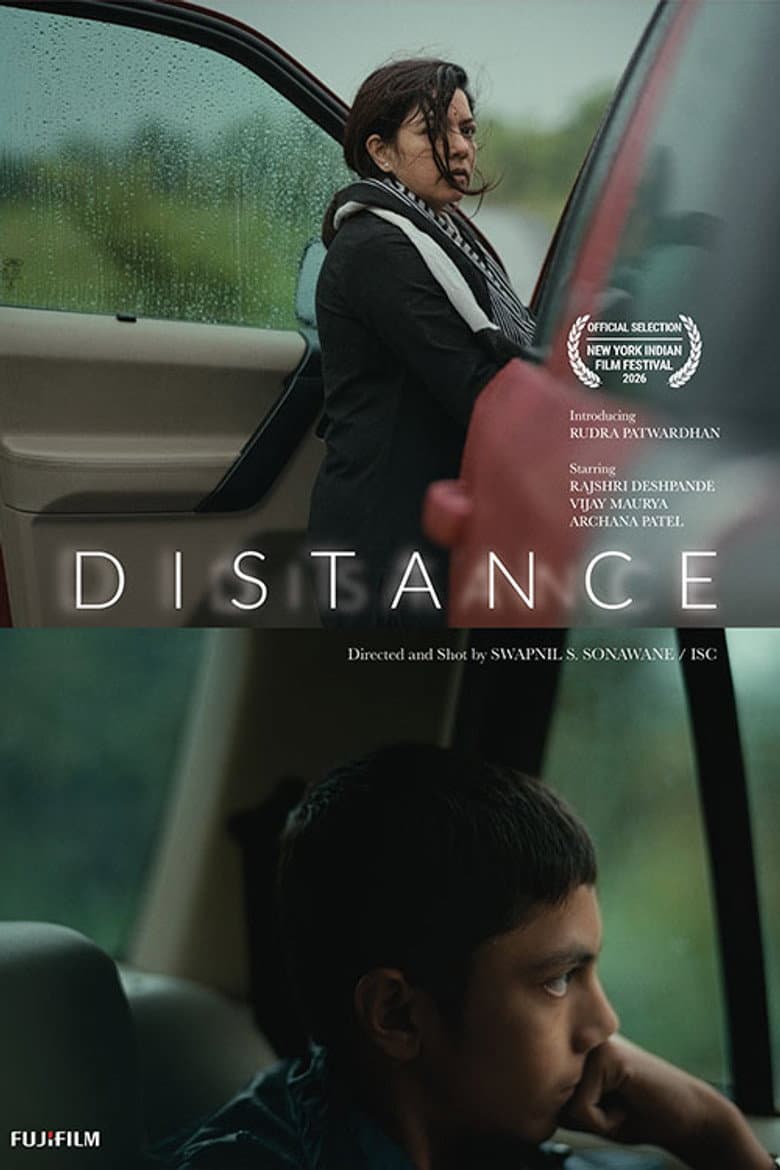
There’s a particular kind of silence that settles between two people who should be close but aren’t. It’s the silence of a car ride that stretches longer than the miles on the odometer, where every attempt at conversation dies before it reaches the passenger seat. That silence is the emotional territory Swapnil S. Sonawane explores in his upcoming short film Distance, a compact 26-minute Hindi drama that arrives on October 29, 2026. It is a story about grief, certainly, but also about the careless words and broken objects that pile up between us, and the terrifying moment when the truth finally demands to be spoken.
Release Date & Where to Watch
Distance is scheduled to release on October 29, 2026. The timing places it just ahead of the Diwali weekend, an unusual slot for such an intimate, 26-minute piece. But the festival period, often associated with family and homecoming, provides a fitting backdrop for a story about a fractured family unit trying to navigate a journey together. Viewers should keep an eye on the major streaming platforms for its digital premiere; a film of this scale - personal, dialogue-driven, and anchored by a single continuous journey - tends to find its home on services that champion independent cinema and short-form storytelling. Given the pedigree of the cast and the director’s reputation, a festival run before or alongside the streaming launch seems likely as well.
Cast & Crew
The film is directed by Swapnil S. Sonawane, who has a strong eye for understated, character-driven narratives. He is adapting a premise that relies entirely on the chemistry between two performers confined to a small space, and his direction will be crucial in ensuring the film never feels static.
Leading the cast is Rajshri Deshpande, one of Hindi cinema’s most quietly powerful actors. Deshpande has built a career out of playing women who carry deep internal weight, and here she embodies Ambika, a woman whose very attempt to do a good deed - driving her late best friend’s son back to school - becomes a minefield of unresolved resentment and guilt. She is joined by Archana Patel, whose role adds texture to the family’s past, and the ever-reliable Vijay Maurya, whose presence in any ensemble brings a grounded, lived-in quality.
Casting a child actor opposite a seasoned performer like Deshpande is always a gamble, but early character descriptions suggest Dhruv is the emotional engine of the film, and his unexplained animosity will be the primary source of narrative tension.
Story & What to Expect
The premise is deceptively simple. Ambika is driving her late best friend’s 13-year-old son, Dhruv, back to his boarding school. The boy’s father has just died suddenly. The journey should be a shared mourning, a chance to provide comfort. Instead, Dhruv radiates an animosity toward Ambika that he refuses to explain. He is hostile, withdrawn, and confrontational.
Sonawane builds tension through accumulation, not explosive confrontations. Every awkward silence, every unreturned glance, every pointed remark from the backseat adds another layer to the film’s central mystery: Why does this boy hate the woman who is supposed to be his mother figure’s closest friend?
The film’s turning point is a beautifully uncomfortable piece of realism. Ambika, distracted or careless, breaks Dhruv’s prized windmill science project - an object that clearly means more to him than a simple school assignment. The destruction of the windmill is not just a plot device; it is a physical manifestation of the chaos adults unleash on children’s lives. It also serves as the match that finally ignites the confrontation.
What follows is the film’s emotional core. Dhruv confronts Ambika with a painful shared secret, one that reframes everything we have seen. This is not simply a story about a boy grieving his father. It is about the secrets adults keep and the price children pay for them. Expect a film that is lean, unsentimental, and emotionally direct. At 26 minutes, there is no room for subplots or filler. Every scene must carry weight, and the final act will likely leave more questions than answers.
Why It's Worth Watching
There are three reasons to seek out Distance. The first is Rajshri Deshpande. Her ability to convey devastation through a subtle tightening of the jaw or a moment of hesitation is worth the runtime alone. She can make a line about a broken toy feel like a confession.
The second is the structure. Sonawane is attempting the cinematic equivalent of a one-act play - a two-hander on a moving stage. Hindi cinema does not often produce these chamber pieces, not even in the short film format. If it works, it will be a masterclass in restraint.
Third, and most importantly, Distance promises to address a theme rarely explored in mainstream Indian storytelling: the secret lives of adults as seen by children. Dhruv’s confrontation is not a temper tantrum; it is an accusation. The film asks uncomfortable questions about loyalty, friendship, and the lies we tell to protect people who may not deserve protection.
The film’s current TMDb rating of 0/10 is simply a placeholder - it has not yet been screened widely. Do not let that deter you. With a cast of this caliber and a director committed to intimacy over spectacle, Distance is the kind of small, sharp film that lingers longer than many bloated blockbusters ever could. It arrives October 29. Clear a half-hour. You may find yourself thinking about the silence in your own car rides for days.