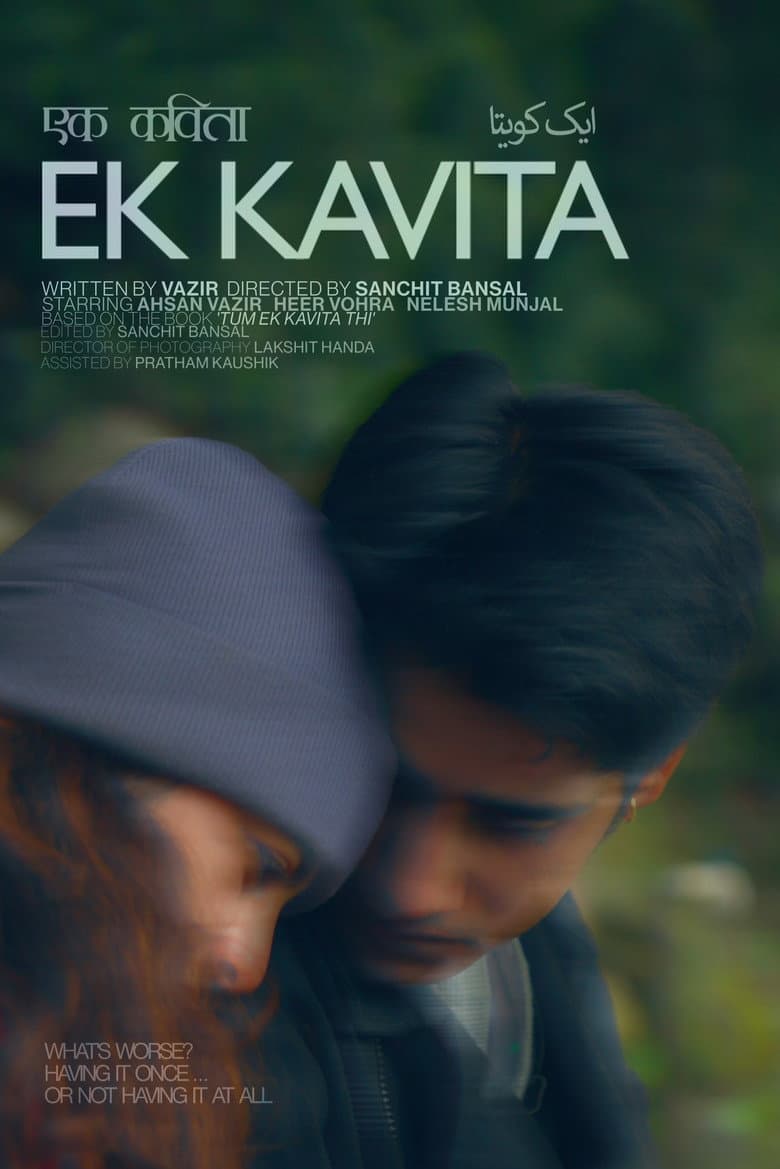
There is a particular kind of ache that comes with finishing a book you wrote for someone who may never read it. Sanchit Bansal’s new short film, Ek Kavita, lives inside that ache. Clocking in at just fourteen minutes, this Hindi drama arrives on the back of a simple premise: a writer shows up at a woman’s door on her birthday, a freshly printed book in hand - one he wrote specifically for her - and discovers something that upends the night entirely. The film, which released on September 20, 2026, is less interested in grand gestures than in the quiet devastation of ordinary timing.
The title itself is a callback. Tum ek kavita thi - the book within the film - translates roughly to “You were a poem.” Bansal’s film picks up precisely where that book ends, treating the written word as a prologue to a far messier reality. Ahsan Vazir plays The Writer, a man who has apparently poured his unspoken feelings into pages rather than conversation. Heer Vohra is Mogu, the woman on the other side of the door, the muse who may or may not have asked to be one. And Nelesh Munjal rounds out the cast as Ishaan, a presence whose exact role in the evening’s unraveling the film wisely keeps close to its chest.
What is immediately striking about Ek Kavita is its restraint. A fourteen-minute runtime leaves no room for melodrama, and Bansal - working in the genre he knows best, the slow-burn emotional drama - uses that limitation as a virtue. The premise is essentially a single encounter: a man, a doorstep, a gift, a revelation. But the film’s ambition is larger than its setup. It wants to examine the gap between the love we narrate and the love we actually live. The book is not just a gift; it is an argument, a confession, and possibly a plea. What The Writer finds at Mogu’s door forces him - and the audience - to confront the uncomfortable truth that devotion, however beautifully rendered, does not obligate anyone to reciprocate.
This is familiar territory for Hindi cinema, but the short film format strips away the usual Bollywood scaffolding. There are no elaborate song sequences, no sprawling family subplots, no climactic monologues delivered in the rain. Instead, Ek Kavita leans on performance and silence. Vazir, as The Writer, must carry the weight of unrequited love without tipping into self-pity - a difficult balance that the film’s tight framing demands. Vohra’s Mogu, meanwhile, is the story’s fulcrum; everything depends on how she receives what is offered and what she chooses to reveal in return. Munjal’s Ishaan adds a third point of tension, complicating what might otherwise have been a two-hander.
The film’s release comes at a moment when Hindi short films are quietly accumulating cultural capital as a format for intimate, character-driven stories that would struggle to sustain a feature length. Ek Kavita fits that mold neatly. It is not trying to be a calling card for a larger franchise or a proof-of-concept for a sprawling epic. It is a complete, self-contained story about a single night that changes how a man understands his own heart. The fact that the film’s TMDb rating currently sits at 0/10 - meaning no aggregate audience score has yet been registered - is less a reflection of quality than of the short film’s ongoing challenge: finding viewers in a marketplace that still treats the format as a niche.
Still, there is something to be said for a film that trusts its audience to sit with ambiguity. The title, Ek Kavita, suggests poetry, but the film seems more interested in what happens when poetry fails - when the metaphor collapses and you are left with two people on a doorstep, a book between them, and no graceful way forward. Bansal, who directed and presumably shaped the story’s voice, appears to understand that unrequited love is rarely cinematic in the moment. It is awkward, mistimed, often embarrassing. The drama comes from the aftermath, from the slow realization that you have handed someone a version of yourself they never asked to meet.
Ek Kavita does not promise resolution. It promises an unraveling, and at fourteen minutes, it has just enough rope to pull the thread without snapping it. For viewers who appreciate Hindi dramas that favor emotional precision over plot mechanics, this one is worth seeking out - not because it answers anything, but because it asks the right question: what do you do with a love that has already been written down when the person it was meant for turns out to be someone else entirely?