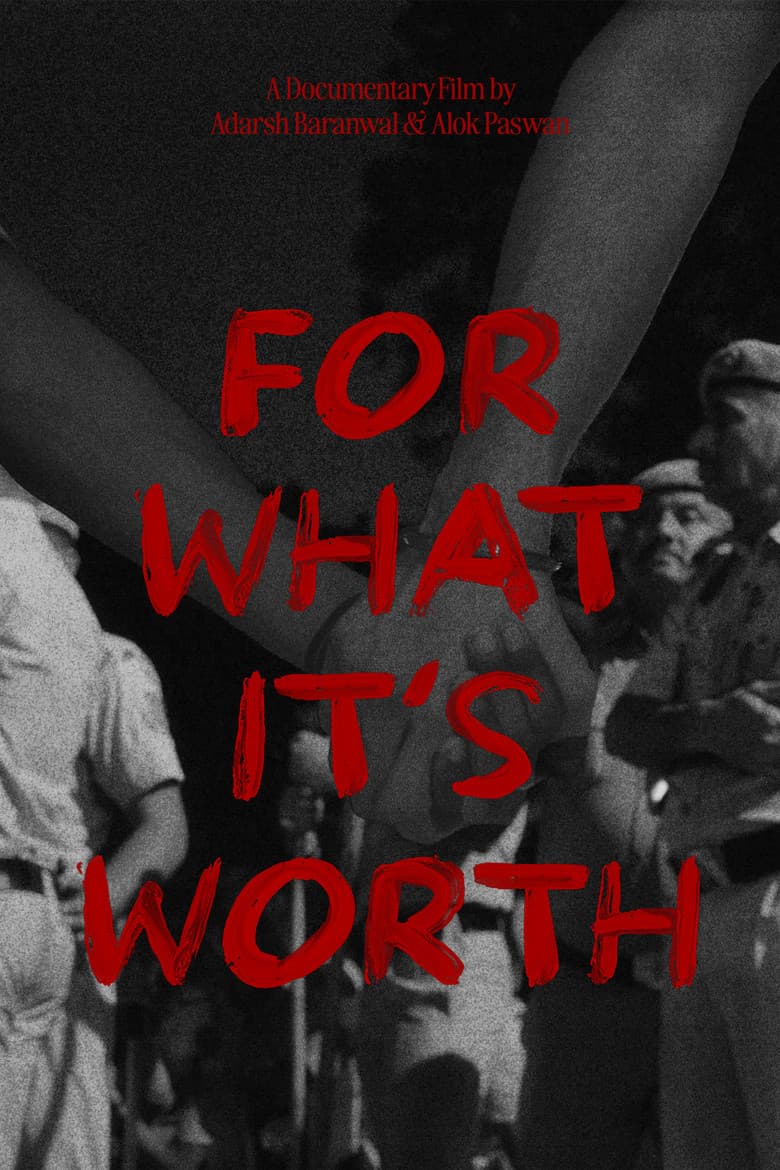
The release of any documentary carries an inherent promise - the promise of a perspective, a truth, or at the very least, a question worth asking. But when a film arrives with the quiet, deliberate subtitle “an attempt to understand a movement,” it raises the stakes considerably. Today, on August 15, 2026, Hindi Movie Buzz takes a closer look at a project that isn’t looking to preach, but to listen. For What It’s Worth is not a sprawling, cinematic spectacle; it is a 35-minute, intimate foray into chaos, confusion, and the human need for clarity. Directed by Adarsh Baranwal, this documentary steps into the eye of a storm that many of us only saw from a distance.
Release Date & Where to Watch
Mark your calendars, because this isn't a film you’ll catch in a traditional multiplex. For What It’s Worth makes its official debut today, August 15, 2026. Given its runtime and its deeply observational, almost journalistic nature, the release strategy feels appropriately modern and accessible. While specific streaming platforms are yet to be formally announced by the production team, the current buzz suggests a digital-first rollout - expected on major OTT platforms that cater to independent and documentary cinema. Think of the usual suspects like Mubi, SonyLIV, or even a curated section on Prime Video. Given the film’s short length, it’s the kind of piece that will likely be paired with a director’s commentary track or a follow-up Q&A, making it a perfect afternoon watch. For now, the best bet is to keep an eye on the official social media handles of the director and the production house, as they are expected to announce the digital partner within days. This is not a wide release; it is a targeted one, aimed at audiences who are genuinely interested in political and social realities rather than pure entertainment.
Cast & Crew
The name in the director’s chair is Adarsh Baranwal, a filmmaker who has consistently shown a penchant for gritty realism. While his previous works have flirted with narrative fiction, For What It’s Worth marks his most explicit step into non-fiction filmmaking. Baranwal doesn't just direct here; he functions as a cinematic chronicler, guiding the camera with a steady hand that respects the raw material. The cast is officially listed as “unknown,” and that is entirely by design. There are no actors here, no scripted dialogues. The real performers are the protesters, the bystanders, the curious onlookers, and the voices of dissent and support who populate Jantar Mantar. The film’s technical crew, though not front-and-center in the promotional material, deserves a nod. The cinematography, which reportedly employs a handheld, vérité style, captures the unvarnished textures of a demonstration - the sweat, the tension, the frayed edges of placards, and the weariness in the eyes of those who have been standing for hours. Baranwal’s role is that of a facilitator, a questioner who knows when to step back and let the moment speak for itself.
Story & What to Expect
The premise is deceptively simple. The film begins in the aftermath of a violent clash on July 20th. The exact nature of the violence is not spoon-fed to the audience; instead, we are dropped into the middle of a consequence. Two filmmakers - Baranwal and an unnamed collaborator - make their way to Jantar Mantar, the historic site of protests in New Delhi, days after the incident. Their goal is not to compile a news report, but to have conversations. The documentary unfolds as a series of dialogues. It seeks to answer a foundational question that often gets lost in the noise of headlines: What exactly was the protest about?
What follows is a mosaic of contradictions. You meet a young student who talks about economic inequality with startling clarity, only to be followed by a middle-aged shopkeeper who is angry about the violence, not the cause. There are moments of profound frustration, where a protester struggles to articulate a demand that has been co-opted by media narratives. The film’s intelligence lies in its refusal to resolve these contradictions. It does not offer a thesis statement; it offers a listening ear. The 35-minute runtime is brisk, and Baranwal wisely avoids exhaustive interviews. Instead, he captures fragments - a shared cup of chai, a heated argument between two strangers, a moment of silence that speaks louder than any slogan. You should expect a film that is less about the "what" and more about the "why." It is a glimpse into the messy, often incoherent process of forming a collective voice. The violence of July 20th serves as the catalyst, but the movie is about the hangover - the period of confusion where people try to piece together what just happened and what it means for the future, without the filter of television anchors or political spin.
Why It's Worth Watching
In an era of hyper-commodified content, For What It’s Worth feels like an anomaly - and that is its greatest strength. This is not a film that will give you satisfying answers. It will not validate your pre-existing political biases, whether you side with the government or the protesters. Instead, it offers something rarer: context. It is a time capsule, preserving the genuine, unfiltered emotions of people who were living through a pivotal moment. Watching the trailer, you get the sense that Baranwal is not trying to be a hero. He’s a conduit.
The film is worth watching for the sheer courage of its approach. It is easy to make a documentary that confirms what the audience already thinks. It is much harder to make one that sits in the gray zone, asking the audience to do the intellectual heavy lifting. The absence of a rating (0/10 on TMDb) is a testament to its newness, but also to its status as a labor of love, not a commercial product. If you are tired of polished, agenda-driven documentaries that tell you how to feel, For What It’s Worth is a refreshing antidote. It is a poignant, raw, and deeply human experiment. The film doesn’t ask you to agree with anyone; it simply asks you to understand. And in a world that is increasingly polarized, that is an act of rebellion. For those who value journalism in its purest form, translated into cinema, this is an essential, if sobering, watch. It’s a film that doesn’t claim to have the worth of the movement figured out; it simply presents the movement for what it is - things that happened, words that were spoken, and the struggle to make sense of it all.