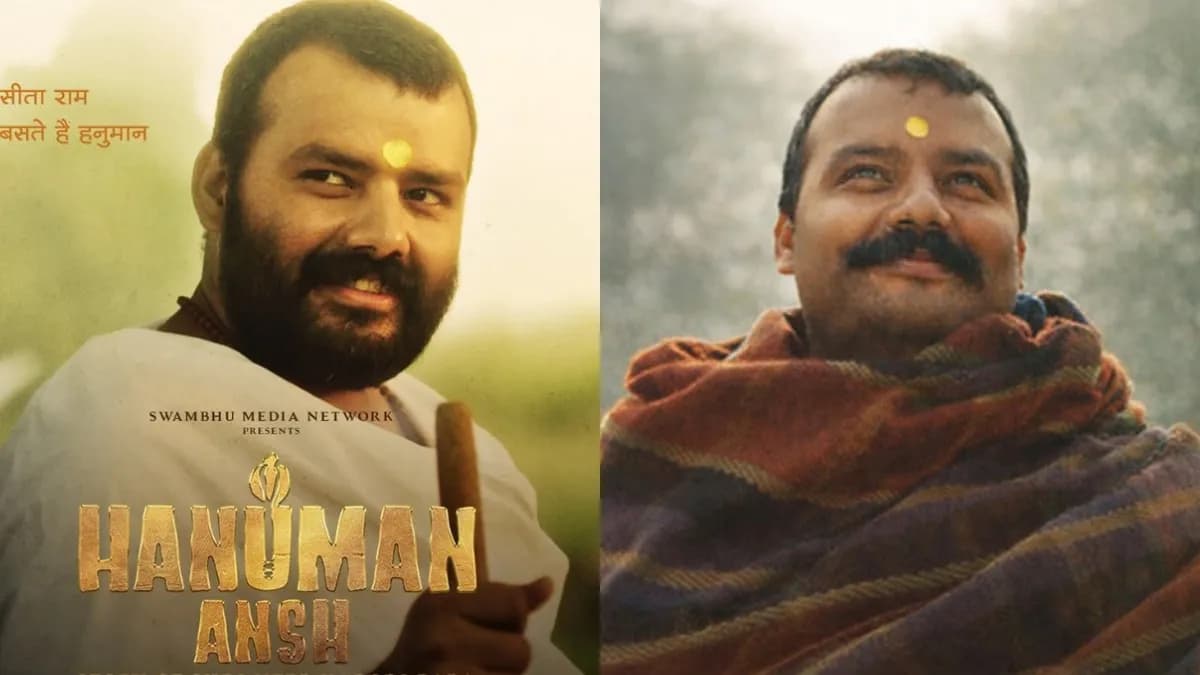
The much-anticipated mythological drama Hanuman Ansh, centered on the life and spiritual legacy of Neem Karoli Baba, has finally hit theaters, and audiences are leaving with more questions than answers. The film, which blends devotion with a high-concept narrative, culminates in a climax that redefines its entire premise. For those who have seen it, the ending is a bold, divisive swing that transforms a straightforward biopic into a cosmic parable about faith, identity, and the nature of divine intervention.
The Climax Unpacked
The final act of Hanuman Ansh abandons the grounded, ashram-based storytelling that dominates the first two hours. The narrative follows a young, cynical software engineer named Arjun (played by a rising star whose name is being kept under wraps for now), who travels to the Kumaon hills to debunk the miracles attributed to Neem Karoli Baba. Throughout the film, he remains a skeptic, attributing the Baba’s feats to mass hysteria and clever sleight of hand.
However, the climax flips the script entirely. As Arjun prepares to leave the ashram after exposing what he believes is a fraud, he suffers a sudden, fatal cardiac arrest. Instead of dying, he finds himself in a void, confronted not by Neem Karoli Baba, but by a colossal, glowing figure of Lord Hanuman. The deity speaks in a voice that is both ancient and familiar, revealing that Neem Karoli Baba was not merely a saint, but a direct ansh - a living fragment - of Hanuman himself, tasked with guiding the modern world away from materialism.
The Shock Twist
The film’s real surprise, however, comes after this celestial revelation. Hanuman informs Arjun that his skepticism was not an obstacle but a test. It turns out that Arjun is not a random visitor; he is the current reincarnation of a devotee who once failed Neem Karoli Baba in a past life. The Baba, knowing Arjun would return in this era of digital cynicism, orchestrated the entire charade - including the "fake" miracles - to bring Arjun to the brink of death so he could finally surrender.
The twist deepens when Arjun is revived on the operating table. He runs back to the ashram, expecting to find the Baba waiting for him. Instead, he finds the samadhi (shrine) covered in fresh marigolds and a note in the Baba’s handwriting: "The ansh is gone; the whole has returned." The film implies that Neem Karoli Baba physically disappeared from the ashram at that exact moment, having fulfilled his cosmic quota by saving Arjun’s soul a second time. The final shot shows Arjun looking at his own reflection in a temple bell, and for a split second, his face morphs into a simian silhouette before returning to normal.
What It Means For The Story
This conclusion reframes the entire film as a divine test rather than a man’s biography. Earlier scenes that seemed mundane - the Baba’s frustrated outbursts, his sudden disappearances, even his love for junk food - are now reinterpreted as Hanuman humanizing himself to connect with a modern audience. The twist suggests that Neem Karoli Baba’s famous 1960s interactions with Western seekers were part of a longer chain of events culminating in Arjun’s "awakening."
The subtitle "Hanuman Ansh" is revealed to be a double entendre. On one level, it refers to the Baba’s essence. But on a deeper plane, it points to Arjun himself - an ansh (fragment) of the divine consciousness that has been asleep until now. The ending leaves room for a sequel, but it also works as a standalone statement: faith does not require proof when the proof is the act of surrender itself.
Audience Reactions And Debate
Early reactions to the climax are sharply divided. Devotional audiences have praised the film for its audacious theological take, calling it a modern retelling of the Ramayana’s moment where Hanuman forgets his own power. Meanwhile, purists and critics argue that the twist undermines the historical reality of Neem Karoli Baba, who was a real, documented figure beloved by millions.
What is not debatable is the visual ambition of the third act. The VFX team has crafted a Hanuman form that feels colossal yet intimate, using a mix of practical prosthetics and CGI to create a deity that feels present. The sound design during the void sequence, which swaps dialogue for a low-frequency chanting that vibrates in the chest, has been singled out as the film’s most immersive element.
The Future Of The Franchise
The director, speaking at a post-screening Q&A, hinted that the ending was designed as a "philosophical doorway" rather than a closed loop. He stated that while the Baba’s physical story is complete, the idea of an ansh allows for infinite narratives. This has led to speculation that the studio is planning an expanded universe, focusing on other "fragments" of deities living among modern society.
For now, Hanuman Ansh ends with a simple, powerful image: Arjun, now a believer, sitting alone in the ashram, serving tea to visitors. He does not speak. He does not perform miracles. He simply points to a small framed photo of Neem Karoli Baba. In that moment, the film suggests, the worship has become the miracle. Whether that is a satisfying resolution or a frustrating cop-out depends entirely on your own belief in the ansh that lies within.
Source: Filmibeat