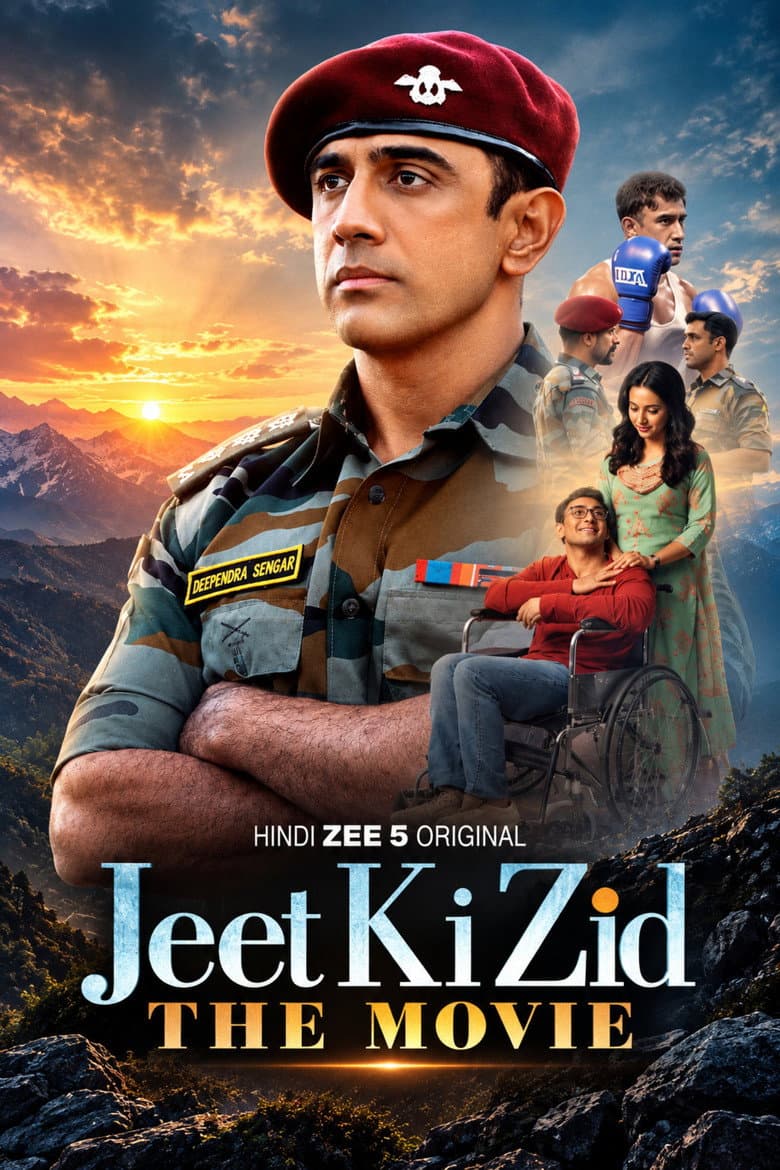
What Jeet Ki Zid understands better than most Bollywood rehabilitation dramas is that a soldier's injury is also an identity crisis. Deep doesn't just miss walking; he misses mattering. Sadh plays this loss in the shoulders and the jaw, in the way he refuses eye contact with anyone who once saluted him. There is a scene - brief, almost throwaway - in which he tries to button his own shirt and simply cannot, and Sadh lets the shame sit on his face for a beat too long. That beat is the movie.
Amrita Puri is the film's quiet engine. Her character is written perilously close to the saintly-wife cliché, but Puri keeps finding small acts of resentment beneath the devotion, a flicker of "how long do I have to hold this together?" that makes the marriage feel lived-in. Sushant Singh, meanwhile, brings a welcome abrasive energy, though the screenplay gives him speeches where it should give him silences.
Mangalorkar directs with restraint - no slow-motion flag-waving, no swelling anthem at the injury. The film's patriotism lives in its refusal to sentimentalise the army; these are men whose discipline becomes both their salvation and their blind spot. The dialogue, however, leans on aphorisms about spirit and defeat that would land harder if the film trusted its images more. At 130 minutes, it also overstays its welcome by roughly fifteen, and the subplot involving a hospital orderly (a reliable source of comic relief) feels imported from a lighter movie.
Still, there is something admirable in a Bollywood film that treats recovery as a grind rather than a montage. When the climax arrives - and it does arrive, with a wheelchair-bound Deep confronting a challenge that is less about his legs than his pride - you feel the weight of every earlier stumble. This is not a flawless film, but it is an honest one, and honesty in this genre is rarer than it should be.