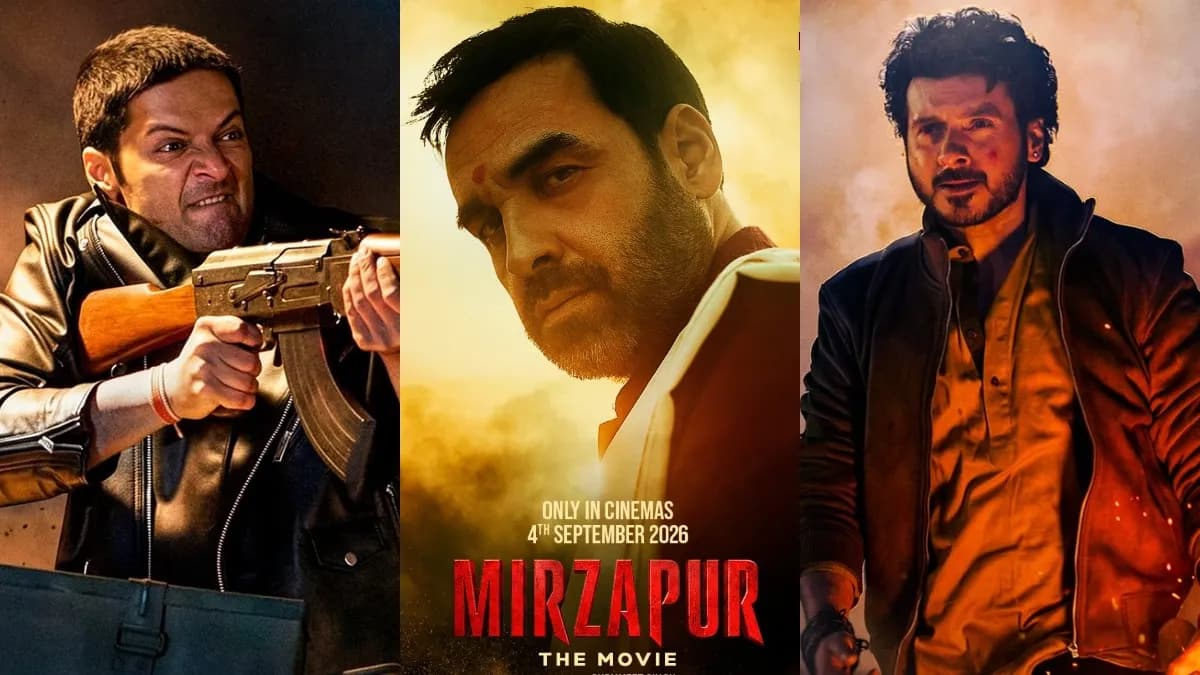
The much-anticipated transition of Mirzapur from streaming series to the big screen has naturally turned the spotlight on its ensemble cast, but a fresh wave of curiosity is now focused on their paychecks. As the film gears up for production, industry insiders and fans alike are buzzing with one burning question: who walks away with the heftiest remuneration - Pankaj Tripathi or Ali Fazal?
While the official numbers remain tightly under wraps, the conversation has shifted to the business of stardom in the OTT-to-cinema pipeline. For years, the show built its identity on a robust ensemble, where every actor, from the leads to the supporting players, carved out a distinct space. However, the leap to a feature film format changes the financial calculus entirely, often turning a collaborative effort into a star-driven proposition.
Pankaj Tripathi, who plays the formidable Kaleen Bhaiya, has become a household name not just for this franchise but for a series of memorable roles across Hindi cinema. His journey from a character actor to a dependable leading presence has been organic, and his fee structure has mirrored that rise. For the film, sources suggest his quote reflects his current standing as a bankable performer who can open a film on his own name, especially in the heartland circuit. His negotiation strength lies in his versatility, but his deep association with Mirzapur is his trump card.
On the other hand, Ali Fazal, who portrays the volatile Guddu Pandit, brings a different kind of leverage to the table. His international exposure, with projects like Victoria & Abdul and his work in Hollywood, adds a global sheen to the project. Fazal’s fee demands have historically been shaped by his dual appeal - he is credible in gritty, desi roles but also carries a cosmopolitan polish. In the film’s financial breakdown, his ask is believed to be on par with Tripathi’s, but the final settlement hinges on how the producers choose to distribute their budget.
What makes this comparison tricky is the nature of the show itself. Unlike a conventional two-hero film, Mirzapur thrives on its sprawling narrative and multiple antagonists. The film is expected to give significant screen time to both characters, but the emotional arc might tilt toward one of them. If the script demands a prolonged face-off, both actors will command similar pay brackets. If one has a more substantial arc, that actor could feasibly push for a premium over the other.
There is also the wildcard factor of the rest of the cast. Actors like Vikrant Massey, who joined the universe in the third season, and veterans like Isha Talwar have their own market rates. However, the film’s budget is likely being structured around two central pillars: Tripathi’s gravitas and Fazal’s intensity. The producers know that a Mirzapur movie does not work without either, so splitting the difference might be the most pragmatic outcome.
That said, a recent trend in Hindi cinema is that streaming giants often budget differently for theatrical releases than for direct-to-digital content. If the film is planned as a hybrid release - first in theaters, then on a platform - the actors might accept a reduced upfront fee in exchange for a profit-sharing deal. Tripathi has historically favored straightforward, high-grossing arrangements, while Fazal has shown a willingness to structure deals around box-office performance. This philosophical difference could be the deciding factor in who officially becomes the "highest-paid" on paper.
Fan theories have also entered the mix. Many believe that Tripathi’s role as Kaleen Bhaiya is the soul of the franchise, and the producers would be foolish not to reward him with the top slot. Others argue that Fazal’s character has undergone a more dramatic transformation, making him the poster material for promotional campaigns, which justifies a higher fee. Without official confirmation, the debate remains a lively one on social media.
Another layer to consider is the production house’s history with both actors. Excel Entertainment, which produces the show, has long-term relationships with both performers. They have grown with the franchise, and their loyalty bonuses might be baked into the film’s contracts, obscuring the headline number. It is plausible that one actor’s base fee is lower, but with backend bonuses, their total take-home surpasses the other.
As of now, the smart money seems to be on a near-equal payout, with Tripathi perhaps inching ahead due to his wider lead role in a feature-length narrative. But this is speculation shrouded in nondisclosure agreements. What is certain is that the Mirzapur film will be a test of how a beloved web series translates to a theatrical event. If it succeeds, both actors will have their quotes revised upward for future projects, making this particular fee battle a stepping stone for bigger paydays ahead.
For audiences, the debate over fees is a distraction from the real prize: seeing these characters on a colossal screen. The chemistry between Tripathi and Fazal, laced with menace and desperation, has been the franchise’s core strength. Whatever their individual earnings, their combined pull at the box office is the only number that will ultimately matter to the studio.
Until the makers decide to pull back the curtain, the highest-paid actor title remains a guessing game. But in the world of Mirzapur, where power dynamics are a central theme, it is fitting that the negotiation behind the scenes might be just as gripping as the drama on screen.
Source: Filmibeat