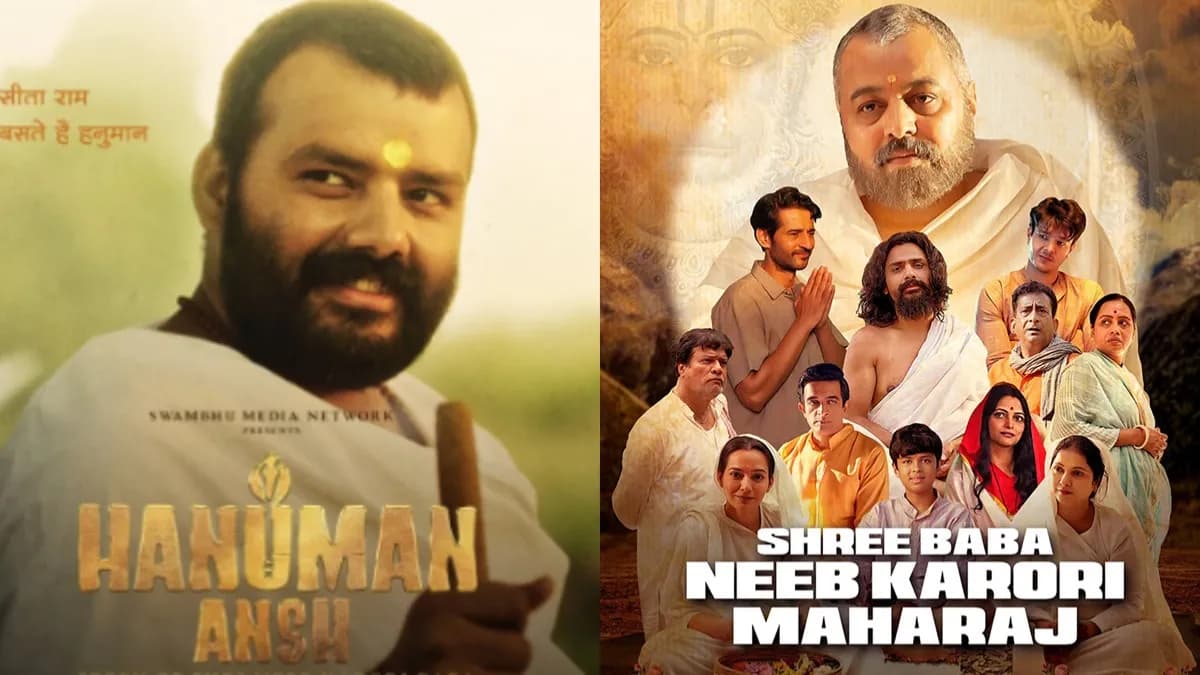
The concurrent release of two films centered on the life and teachings of Neem Karoli Baba in 2026 has produced one of the year's most unexpected box office narratives. While both projects drew from the same well of devotion, one has vaulted into record books as a historic hit, and the other has struggled to find its footing. The contrast has animated conversations across the Hindi film trade for weeks.
The breakout title, Hanuman Ansh, has become the season's defining success story. Industry watchers attribute its rise less to spectacle than to something harder to manufacture: an emotional contract with its audience. The film positions the revered saint not as a remote historical figure but as a living presence woven into the everyday anxieties of ordinary families. That choice, according to exhibitors, is what pulled repeat viewers into theaters, often with older relatives in tow.
Trade analysts point to strong word-of-mouth in the Hindi belt, particularly in cities whereNeem Karoli Baba's following runs deep. Morning shows that began with modest occupancy reportedly swelled by evening as social media posts about the film's climactic sequences spread. Distributors describe a pattern rarely seen in 2026: families treating the film as a pilgrimage rather than a pastime.
The second film, by contrast, arrived with comparable spiritual intent but a different creative grammar. It leans on a more meditative, non-linear structure, and that artistic choice appears to have limited its commercial reach. Some critics praised its restraint; audiences, however, largely stayed away. The result is a cautionary tale about how devotion translates to the box office - the subject alone does not guarantee a crowd.
What separates the two, several producers argue, is the handling of faith itself. Hanuman Ansh treats the saint's presence as an active force in the narrative, while the other film observes him from a distance. One invites the viewer into the story; the other asks the viewer to watch it unfold. In a market where ticket buyers increasingly choose films that promise an experience, that distinction has proven decisive.
There is also the matter of timing and scale. Hanuman Ansh mounted a wider release from the outset and benefited from a promotional campaign that leaned on devotional communities rather than conventional celebrity marketing. The rival film opened on a narrower footprint, which made it harder to build the kind of momentum that turns a film into an event. Once the gap in footfalls became visible, screens began shifting in favor of the stronger title within days.
The two-film moment has revived an older debate in Hindi cinema: how to portray figures of faith without reducing them to either hagiography or heritage spectacle. Directors working in this space say the audience is now more discerning. They want reverence, but they also want storytelling craft. A devotional subject, one filmmaker noted, cannot by itself rescue a film from narrative inertia.
For the makers of Hanuman Ansh, the win is both commercial and cultural. The film has inserted a spiritual figure into mainstream conversation in a way that few 2026 releases managed. Devotional gatherings have reportedly doubled as informal promotional events, with viewers sharing their own family connections to the saint after screenings. That organic overlap between cinema and community is precisely what eluded the competing project.
The industry is watching closely. Studios that had shelved spiritual biopics are said to be revisiting those files, though the lesson from this twin release is not simply that faith sells. It is that execution, emotional clarity, and distribution strategy decide which of two similar ideas becomes a phenomenon and which becomes a footnote.
Whether the success of Hanuman Ansh signals a durable trend or a single, unrepeatable moment remains an open question. What is clear tonight is that one film turned devotion into a shared theatrical ritual, and the other, for all its sincerity, could not. In an industry obsessed with formulas, the year's most instructive box office story is about two films that looked alike on paper and could not have been more different where it counted.
Source: Filmibeat