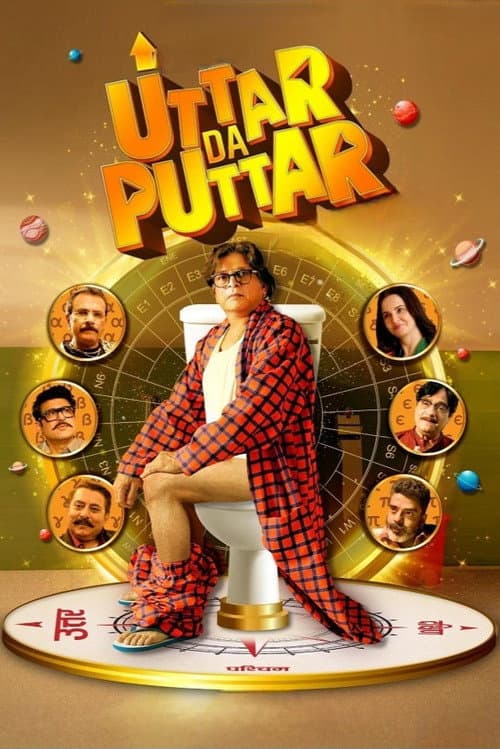
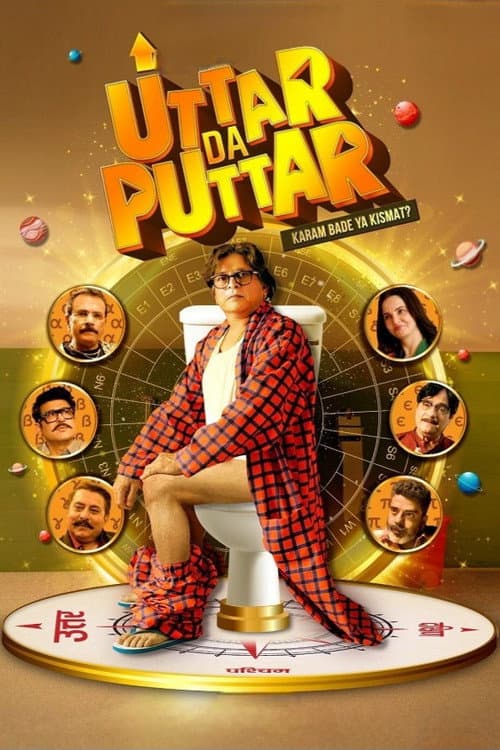
The universe, as any self-respecting Bollywood buff knows, has a peculiar sense of humour. It sends a jackpot when you’ve sworn off gambling, or a marriage proposal right after you’ve deleted the matrimonial apps. But what if the cosmic joke got a little more specific? What if it decided to mess with your furniture arrangement? That’s the delightfully absurd premise of Uttar Da Puttar, a Hindi comedy that arrived in theatres on July 24, 2026, and is now finding its audience in the post-monsoon lull. Directed by Ravinder Siwatch, this 103-minute ride isn't about a son from the north, despite what the title might suggest to the uninitiated. It’s about something far more potent and, frankly, more terrifying to the average Indian household: vastu shastra.
The film, which counts Annu Kapoor, Rukhsar Rehman, Brijendra Kala, and Pavan Malhotra among its formidable ensemble, doesn’t waste time on preamble. It drops us straight into a bustling Punjabi household in Delhi, where the patriarch, a wonderfully flustered Kapoor, runs his life by the sacred geometry of his home. Every door facing, every mirror angle, every kitchen corner is dictated by a worn-out compass and a lifetime of obeying celestial direction. His world is a tightly controlled grid of auspicious placements. Then, a twist of fate - or perhaps a particularly mischievous renovation - knocks the entire compass off its axis. The result isn't just a bad feng shui day; it’s a cascading avalanche of bad luck, zero luck, and completely bewildered luck. The central joke is a smart one: what happens when a man who believes his destiny is literally carved into his walls suddenly finds those walls rearranged?
At its core, Uttar Da Puttar is a battle between dogma and chaos, played for laughs but grounded in a very real, very relatable anxiety. Siwatch, who previously navigated the terrain of small-town eccentricities, understands that comedy works best when the stakes feel genuinely high to the characters. For Kapoor’s protagonist, a misplaced shoe rack is not a minor inconvenience; it is an invitation for bankruptcy, illness, and his daughter never marrying. The script smartly contrasts his rigidity with the laid-back pragmatism of the younger generation, personified by the ever-reliable Sumit Gulati and Jeeveshu Ahluwalia, who view their father’s compulsions as harmless eccentricities until they themselves become collateral damage of a vastu-induced curse.
The real pleasure, however, lies in watching the ensemble merely react to the ensuing madness. Rukhsar Rehman, playing the long-suffering matriarch, delivers her usual grounded performance, the calm eye of a storm she secretly enjoys because it humbles her husband’s pomposity. Brijendra Kala, as a suspiciously knowledgeable neighbour who claims to be a "vastu consultant" but appears to have learned everything from a pirated pamphlet, is a scene-stealer. His pseudo-intellectual advice - a blend of mangled Sanskrit and pure nonsense - pushes the family into increasingly ridiculous situations. Pavan Malhotra, meanwhile, brings his signature heft to a role that initially seems like a side gig - perhaps a sceptical cop or a wily property dealer - but evolves into the film’s moral compass, challenging the idea that our futures are written in brick and mortar.
The film’s genius lies in its refusal to pick a side outright. Is vastu real? Is it all placebo? Uttar Da Puttar doesn't preach; it merely observes the absurdity of our attempts to control the uncontrollable. A scene involving a mirror covered in a red cloth, because the reflection supposedly brings the wrath of Saturn, spirals into a slapstick sequence involving a cat, a bucket of water, and Brijendra Kala falling off a ladder, that had preview audiences in splits. It’s clever chaos that doesn't let up.
However, beneath the laughter, Siwatch is asking a more profound question about agency. In a country where astrology apps are routinely consulted before a job interview and vastu corrections are a common clause in property deals, the film taps into a collective neurosis. It suggests that while seeking guidance from the stars or the corners of your living room is fine, surrendering your free will to them is the real punchline. The film’s emotional peak arrives not during a comedic beat but in a quiet confrontation between Kapoor and his son, where the father confesses his terror of a chaotic world he can't regulate, and the son replies that the only true direction is forward, even if it's blindly.
Running at a taut 103 minutes, the film never overstays its welcome. The editing is crisp, ensuring that the jokes land without lingering. The dialogues, primarily a blend of conversational Hindi with a Punjabi swagger, are sharp and filled with double entendres that don't rely on crudity. Annu Kapoor, a veteran of playing eccentric uncles and godmen, sinks his teeth into the lead role. His physical comedy - from the way he reacts to a wrongly placed shoe as if it were a bomb - is a masterclass in restraint and timing. He makes you laugh at a man’s obsession, but you never hate him for it; you pity him, and maybe recognise a bit of his fear in yourself.
While TMDb reviews are currently non-existent, suggesting it’s still flying under the radar, the word-of-mouth for Uttar Da Puttar is likely to be built on its repeat value. It’s the kind of film you catch on a lazy Sunday afternoon and find yourself quoting for weeks. It’s not a cinematic earthquake; it’s a charming, deliberate nudge in the ribs. In a film landscape dominated by VFX-heavy blockbusters and high-octane action, this modest comedy feels like a breath of fresh - and correctly ventilated - air. So, go ahead. Watch it. But for your own good, avoid sitting facing the television unless you are ready to face the consequences. Or, as the film hilariously suggests, just turn the television around and blame the west wall.