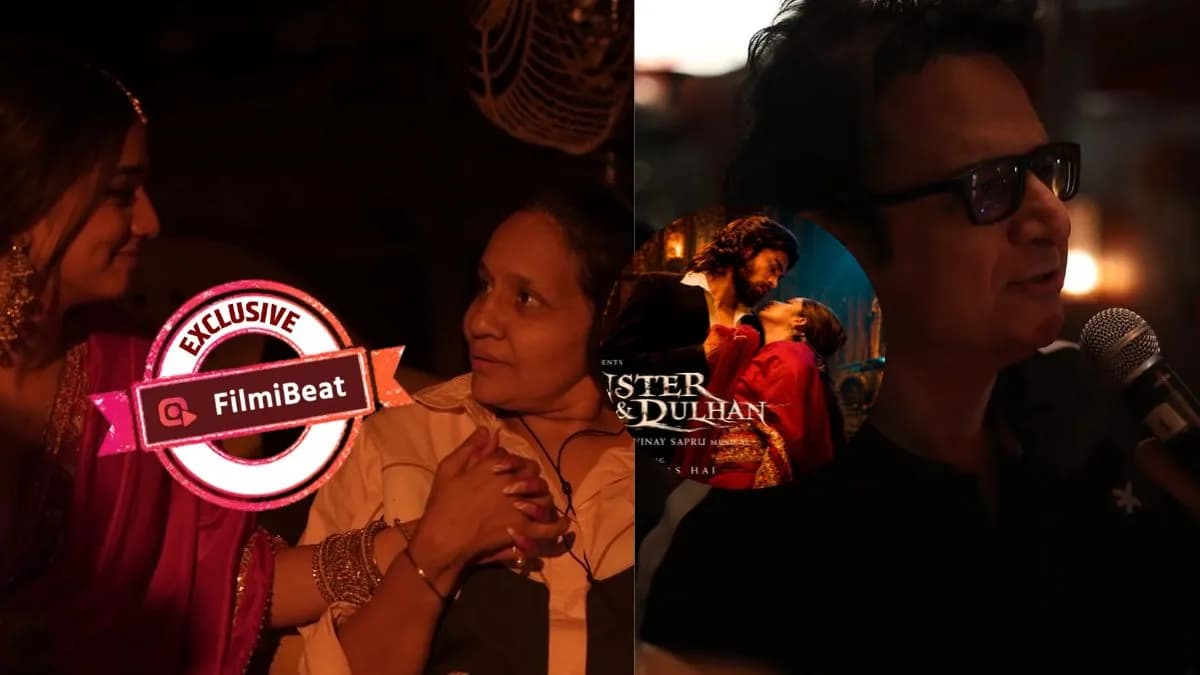
Filmmaker duo Radhika Rao and Vinay Sapru have opened up about the central question that drove them to make their upcoming film "Monster & Dulhan," framing it around one of the oldest and most haunting ideas in storytelling: whether love can outlast death itself. In an exclusive conversation, the director pair explained that the film grew from their fascination with the thin line between devotion and obsession, and with what happens when affection refuses to end simply because a life has.
Rao and Sapru, who have spent years working together as a writing-directing team, described the project as an attempt to explore romance through a darker, more supernatural lens than their previous work. The title itself, they suggested, points to the tension at the heart of the story - one half of the name evokes something monstrous, the other something bridal and hopeful, and the film deliberately refuses to resolve that contradiction too neatly.
An Idea That Refused to Let Go
According to the duo, the concept behind "Monster & Dulhan" came to them not as a single flash of inspiration but as a question they could not stop returning to. They said they kept asking themselves whether love, once it takes root, can ever truly be finished, or whether it lingers in some form after the person who felt it is gone. That curiosity, they added, gradually took shape as a narrative about a bond that survives beyond the natural order of things.
The filmmakers stressed that the film is not interested in horror for its own sake. Instead, they positioned the supernatural elements as a way of putting a very human emotion under pressure - testing how devotion behaves when it is stripped of ordinary limits. The terror in the story, as they described it, comes less from external threats than from the question of what people are willing to hold on to, and what holding on too tightly might turn them into.
In the conversation, the pair also touched on the idea that grief and love can become difficult to separate. They noted that when someone refuses to let go, the act can look like the deepest form of loyalty or like something quietly frightening, depending on where you stand. That ambiguity, they said, is exactly the space they wanted "Monster & Dulhan" to occupy.
A Partnership Built on Shared Instincts
Rao and Sapru spoke about how their long-running collaboration shapes the kind of stories they choose. Working as a two-person unit, they said, means ideas are debated and reshaped before they ever reach a script, and a premise as delicate as this one benefits from that back-and-forth. They described a process in which one of them will push an emotional beat as far as it can go while the other checks whether it still feels truthful.
The directors indicated that the film's romantic core and its unsettling edges are not separate tracks but the same track viewed from different angles. Their aim, as they put it, was to make audiences feel for the characters even as they grow uneasy about them, so that the question in the title becomes something viewers carry out of the theatre rather than a puzzle the film solves for them.
They also acknowledged the challenge of balancing spectacle with intimacy. A story built on a premise this big, they said, can easily tip into pure sensation, and their priority was to keep the emotional reality of the central relationship intact even as the film leans into its more fantastical territory.
What Audiences Can Expect
Beyond the thematic work, Rao and Sapru kept plot specifics close to the chest, choosing to speak in terms of mood and intent rather than revealing narrative turns. They made clear, however, that the film is designed to sit at the meeting point of romance and the uncanny, and that they see it as a natural extension of their interest in pairing big feelings with heightened situations.
What the directors were willing to say outright is that "Monster & Dulhan" asks its audience to consider love as something with a life of its own - something that may not respect the boundaries we assume exist between the living and the dead. Whether that idea proves comforting or chilling, they suggested, is a matter each viewer will have to settle for themselves.
The film, made in Hindi, marks another chapter in the pair's continuing work behind the camera. With this exclusive discussion, Rao and Sapru have given their first detailed account of the thinking behind the project, and their answer to the question in the headline appears to be deliberately open-ended - one that they would rather viewers debate after watching than hear from the makers in advance.
Source: Filmibeat