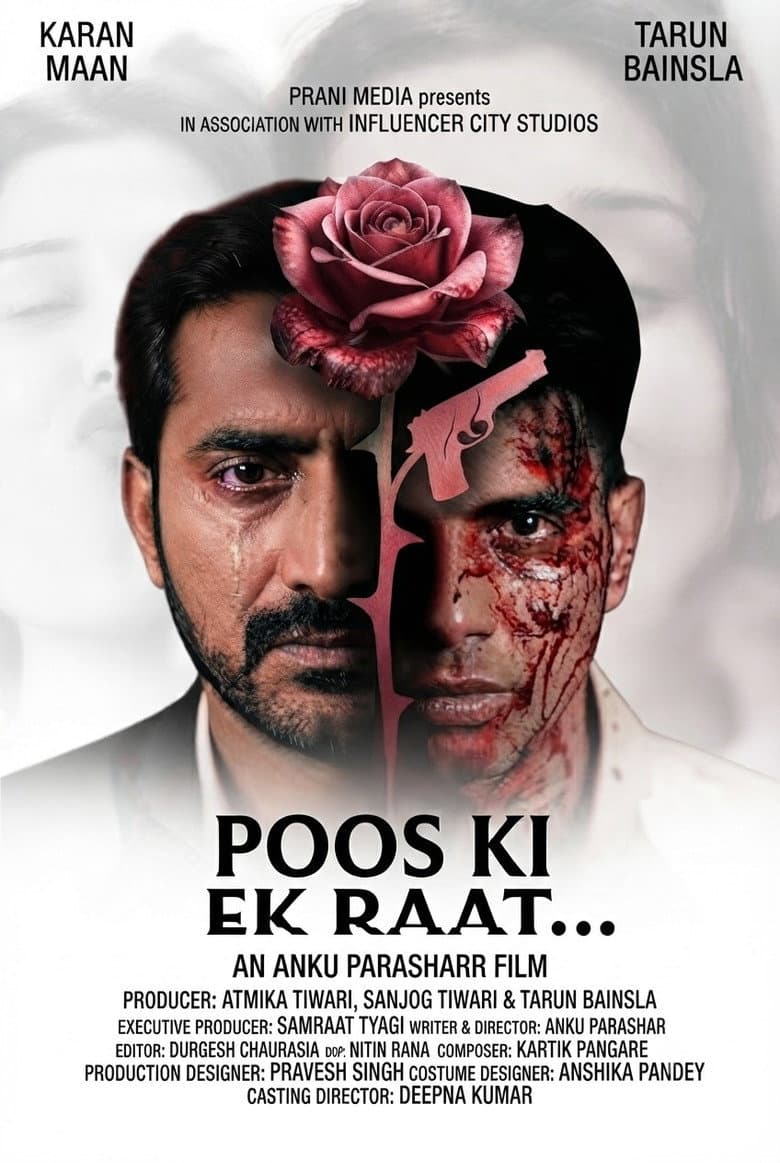
The knock comes at the worst possible time. Not that there is ever a good one anymore. In Anku Parasharr's Poos Ki Ek Raat, a 39-minute Hindi mystery drama that arrived on September 7, 2026, Er. Ankur Sharma has barricaded himself inside his home, a year into a pandemic that has already ended the world. The virus came from China, and it took everything else with it - cities, routines, the future. What remains for Ankur is a radio, a set of lockdown rules repeated like scripture, and a door that will not stop being knocked on.
It is a premise that sounds drawn from the last few years we all lived through, and that is precisely the point. Parasharr, making his mark with this compact BOLLYWOOD production, uses the familiar grammar of isolation - the sanitised hands, the sealed doors, the voice on the radio - and bends it toward something stranger and more interior. Because the threat in Poos Ki Ek Raat is not only outside. It is also memory.
Tarun J. Bainsla plays Ankur, and he carries almost the entire runtime on his shoulders, largely alone in a room that grows smaller with every scene. It is a performance built on listening. Ankur tunes in to a telecast of Munshi ji's story "Poos Ki Raat," that beloved tale of a poor farmer and his cold, sleepless night guarding his field. The allusion is deliberate. Munshi ji wrote about a man trapped by circumstance, waiting for dawn, fighting to protect what little he had. Parasharr places that story inside a lockdown and lets it echo. Ankur is also guarding something. He is also waiting. He is also cold.
But the film refuses to settle into simple parallels. Karan Maan appears as Monty, Ankur's friend, and Saloni Sandhu as Saloni, the girlfriend he cannot reach, and their presence arrives in fragments - the way memory actually works when you are alone too long. A voice, a glance, an unfinished argument. These are not flashbacks staged for our convenience. They are intrusions, and the film treats them with the same unease as the knocking.
The title itself carries weight for Hindi-speaking audiences. Munshi Premchand's story is a staple of school syllabi, a text most viewers will have read and perhaps taken for granted. Repurposing that title for a pandemic-era mystery is a sly move on Parasharr's part. It signals that what we are watching is a kind of national memory too - the country's long acquaintance with hardship, now updated for a generation that experienced it behind closed doors.
What gives the film its charge is the guilt underneath. The synopsis is careful with its language: Ankur is "lost in the memories of his sin," knowing the truth of death. So this is not merely survival. Something happened before the lockdown, something involving Saloni and Monty, and the isolation has given Ankur nothing to do but replay it. The radio crackles. The rules are read out. And the door. Always the door.
Who is knocking? Parasharr leaves that for the audience to decide, and the film's marketing leans into the question with an almost playful confidence. It is the right instinct. In a story this contained, the mystery is less about a reveal than about what the answer would mean for a man who already suspects he deserves whatever is waiting.
At 39 minutes, Poos Ki Ek Raat sits in an interesting space - too long for a short, too short for a conventional feature, and clearly comfortable there. Streaming-era Hindi cinema has been quietly making room for this kind of mid-length storytelling, and Parasharr's film fits the format without feeling stretched or truncated. The runtime is part of the design. It mirrors the compressed, repetitive rhythm of lockdown life, where days blur and yet every hour is accounted for.
The film's TMDb rating currently sits at 0/10, which, given its September release, almost certainly reflects a scarcity of votes rather than audience judgment. Such ratings are common for small independent titles with limited visibility, and they tend to shift once viewership builds.
For an industry often accused of chasing scale, a film like this is a reminder of what Hindi cinema can do with a single room, one actor, and a fear we all recognise. Parasharr is not interested in spectacle. He is interested in the sound of knocking, and in how long a man can pretend he has not heard it. Does Ankur open the door? The film has an answer, and it wants you to come find it yourself.