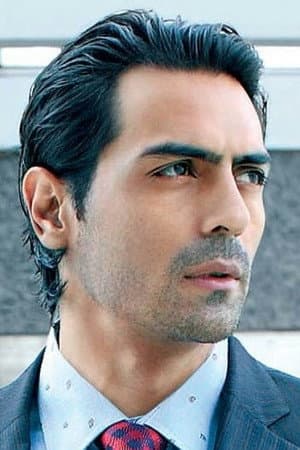
Arjun Rampal: A Career In Hindi Cinema is the story of a performer who began as a face a film could be sold on and became something more durable: the presence that holds a large film together. He entered Hindi cinema in 2001 and has worked steadily since, across romance, action, thrillers and political drama. What makes his filmography worth studying is not a single hit but a pattern. The leading man of his early years gave way to the antagonist and the ensemble player, and it is in that second phase that his reputation was secured.
 Photo: TMDb
From Lead Roles To Character Turns
Rampal arrived in 2001 with Pyaar Ishq Aur Mohabbat, a romance directed by Rajiv Rai. The same year he led Deewaanapan as Suraj Saxena. Hindi cinema uses the word "lead" for the performer who carries the story and whose face the film is sold on, and for several years Rampal was that. The early stretch placed him at the centre of romantic dramas: Dil Hai Tumhaara in 2002, Dil Ka Rishta in 2003 and Vaada in 2005. He tested other ground too, working in action with Asambhav in 2004 and in thrillers with Yakeen in 2005 and I See You in 2006, while the industry still cast him primarily as a romantic figure. Alag in 2006 added another title to that busy middle period.
Then came a pair of ensemble roles in 2006 that quietly widened his standing. Don placed him as Jasjit Ahuja, called JJ, and Kabhi Alvida Naa Kehna as Jai. Neither part asked him to carry the film. Both asked him to fit into a larger machine, and he did. Honeymoon Travels Pvt. Ltd. in 2007, as Jignesh, showed a similar appetite for smaller ensemble work. For a reader outside the region, this is the first clue to how Hindi cinema actually runs: its biggest films are often built from several strong presences rather than one, and the performers who can serve that structure are valued differently from those who top the bill.
The Films That Define The Body Of Work
Om Shanti Om in 2007 gave Rampal the role of Mukesh Mehra, known as Mike, a film producer whose actions set the plot in motion. The story follows an aspiring performer, Om Prakash Makhija, and a famous starlet, Shantipriya, who are murdered in the early 1970s; thirty years later, the reincarnation Om Kapoor investigates what happened to them. As Mike, Rampal played against the warmth audiences associated with him, and the part is widely remembered.
Housefull in 2010, as Major Krishna Rao, put him inside a comedy. Ra.One in 2011 cast him in the title role, an antagonist from an action game who takes physical form, leaving the game's less powerful protagonist to save the world. It was a rare instance of a Hindi film built around a villain and a technical effects showcase, and it pushed him further from the romantic centre. Later work turned toward social and political material. Chakravyuh in 2012 sat in the socio-political space, Inkaar in 2013 dealt with a crime drama, D-Day in 2013 returned him to action, and Roy in 2015 to the thriller. Dhaakad in 2022 brought him back to the crime drama as Rudraveer. These are not all leads. Many are supporting turns, and that shift is central to how his career is understood.
Recognition And The Pattern Behind It
Rampal's accolades include a National Film Award for Best Supporting Actor and a Filmfare Best Supporting Actor Award. Both are mainstream measures of merit in Hindi cinema: the National Film Awards are given by a government body and carry particular prestige, while the Filmfare Awards are the industry's long-running popular honours. The recognition is telling. It arrived for supporting work rather than for the romantic leads of his early years, and it confirmed a direction he had already chosen rather than redirecting him.
Two strands run through the filmography. One is the antagonist or morally complicated figure: Mike in Om Shanti Om, Ra.One in Ra.One, Rudraveer in Dhaakad. The other is the ensemble player who strengthens a film without dominating it, seen in Don, Kabhi Alvida Naa Kehna, Housefull and Honeymoon Travels Pvt. Ltd. Neither strand depends on being the biggest name on the poster, and that is the point. His value lies in range and reliability rather than in a single fixed persona.