The courtroom in Subhash Kapoor’s universe has never been a place of quiet reverence. It is a theatre of the absurd, a colliding circus of legal loopholes, moral grandstanding, and the occasional flying slipper. And with Jolly LLB 3, the director doesn’t just reopen the case - he detonates the entire gallery. Released on September 19, 2025, this 156-minute satire of girth and gall is less a sequel and more a heavyweight championship bout, finally pitting the two most beloved underdogs of Hindi cinema against each other in a fight neither can win, but both refuse to lose.
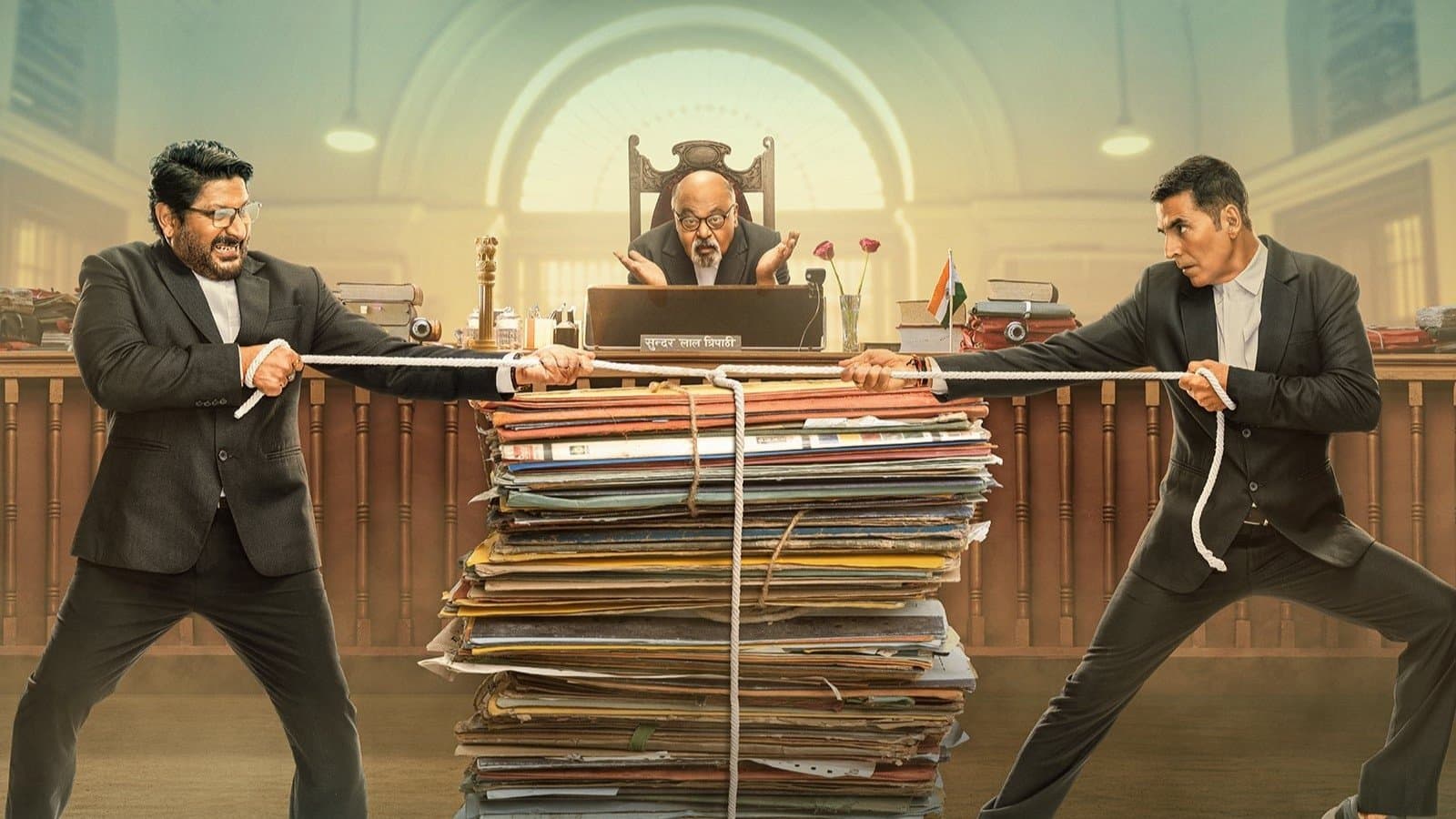
The premise is deceptively simple, as all great con jobs are. A penurious widow, Janki Devi Solanki, played with heartbreaking, steel-eyed dignity by Seema Biswas, seeks justice against business tycoon Haribhai Khaitan, a role Gajraj Rao sinks his teeth into with oily, entitled relish. But this is not a simple David versus Goliath story. The twist is that David has two lawyers, and they are both named Jolly. Akshay Kumar returns as Jagdishwar “Jolly” Mishra, the loud, confident, and often ethically flexible lawyer from the 2017 sequel. Arshad Warsi slips back into the ink-stained robes of Jagdish “Jolly” Tyagi, the small-town, morally bruised advocate who won our hearts in 2013. For the first time, these two titans of courtroom theatre are on opposite sides of the bench, and the resulting clash is a joy to behold.
Kapoor, who wrote and directed the franchise, understands that the real drama is never in the law books but in the men who wield them. Warsi’s Tyagi is a man haunted by the compromises he’s made; his eyes carry the weight of every bribe he never took but watched others swallow. Akshay’s Mishra, by contrast, is a creature of the city’s glitter - confident, cocksure, and dangerously good at spinning narratives. Watching them circle each other in the press, trade barbs in the corridor, and then go for the jugular in front of Justice Sunderlal Tripathi is pure cinematic electricity. Saurabh Shukla, returning as the rumpled, often irritated, and perpetually snack-deprived judge, provides the film’s comic and moral spine. His withering glances and offhand observations cut through the bombast, reminding us that this is, at its heart, a tragedy wearing a comedy’s clothes.
But where the film truly scores its knockout is in its refusal to let the satire remain quaint. The central conflict - the gulf between the privileged and the people on the other side of the spectrum - is not a mere backdrop. It is the very walls of the courtroom. Haribhai Khaitan is not a caricature of evil; he is a monument to systemic impunity. Rao plays him with a chilling placidity, as if his crimes are merely accounting errors in the ledger of life. Against him, Biswas’s Janki Devi is a sliver of truth. Her silence is louder than any argument Warsi or Akshay can muster, and her testimony - delivered without melodrama - lands like a hammer on glass. It is a performance that anchors the film’s fraying edges, reminding us why we care about this ludicrous legal squabble in the first place.
The runtime of 156 minutes is a bold challenge in an era of quick cuts and shorter attention spans. Yet Kapoor earns most of it. He allows scenes to breathe, letting the awkward pauses and quiet humiliations of a staggering justice system play out in real time. A subplot involving Ramarao Solanki, played by the excellent Robin Das, adds a layer of quiet devastation to the proceedings, grounding the high-stakes drama in the grim reality of police brutality and institutional neglect. Amrita Rao’s Sandhya and Huma Qureshi’s Pushpa, the wives of the two Jollys, aren’t just decorative support; they are the consciences their husbands keep trying to outrun. Their exchanges, laced with a shared exasperation and a fondness for their flawed men, offer the film’s most human moments.
With a TMDb rating of 6.574/10, Jolly LLB 3 has proven divisive - a film too big for its britches for some, a necessary reckoning for others. And perhaps that is the point. Kapoor isn’t interested in easy resolutions or a clean verdict. He is interested in the process, the heat, the circus. The final act, which sees the two Jollys face off in a debate that feels less like law and more like philosophical warfare, is Shakespearean in its ambition. They are not fighting for a client; they are fighting for a definition of justice itself, even as they know - just as the audience does - that neither definition is pure.
The film’s ending, which I will not spoil, is not a victory lap. It is a sour, ambiguous, and hauntingly realistic nod to the way justice often feels in India: delayed, diluted, and paid for by the poor in sweat and blood. Jolly LLB 3 is not merely a film about a legal case. It is a mirror held up to a society that loves its heroes but rarely feeds them. It asks a question that lingers long after the lights come up: when the privileged and the powerless stand in the same court, is the law a shield, or just a sharper sword? The answer, delivered with a laugh that catches in your throat, is that it is both - and neither. In that grey space, the two Jollys finally find their truest selves.