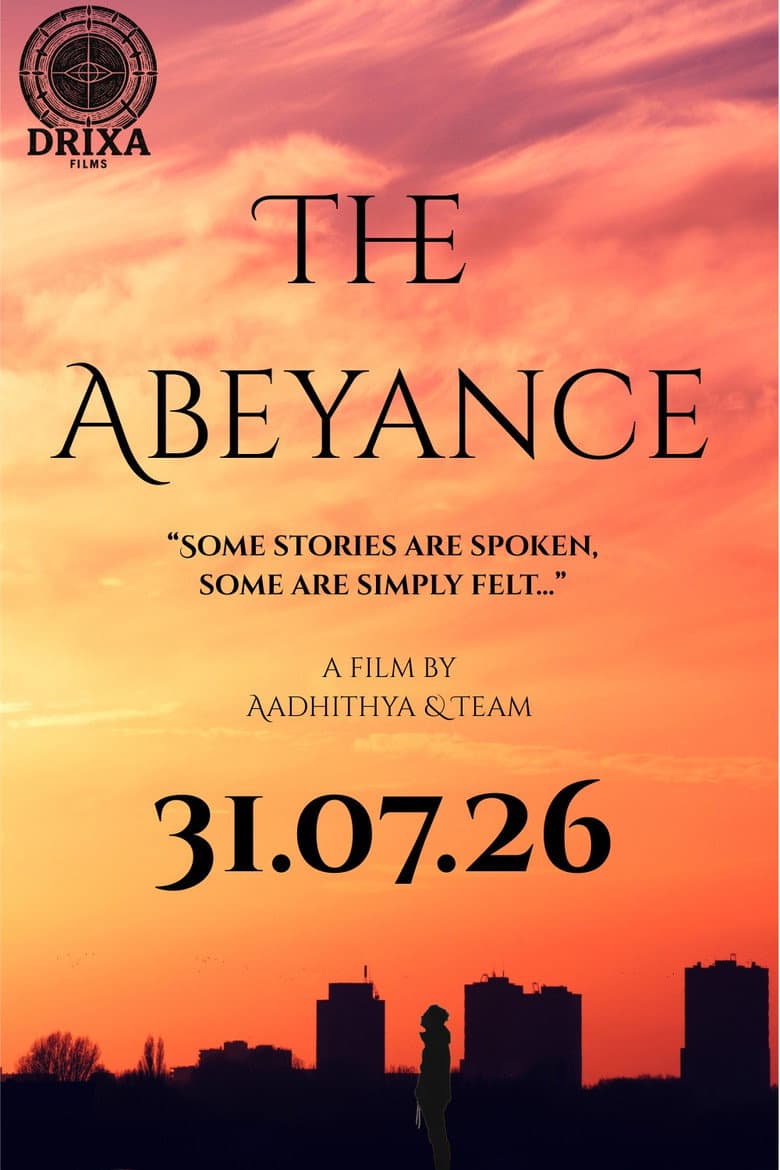
There is a particular kind of silence that follows a profound loss - not the quiet of an empty room, but the heavier, pressurized stillness of a life interrupted. It is this fragile, unspoken terrain that director Aadhithya Sankara Mahadevan navigates in his new short film, "The Abeyance." Clocking in at a taut 16 minutes, this Hindi drama isn't interested in grand gestures or sweeping declarations. Instead, it offers a microscopic, deeply affecting look at the fragile mechanics of healing, arriving in cinemas today, July 31, 2026.
The film centers on Adrika, played with a haunting, internalized grief by Rijuta Sharma. Adrika is a young woman caught in a state of suspended animation, a living embodiment of the film's title. She is not moving on, because to do so would feel like a betrayal of what she has lost. Her world has shrunk to the size of her sorrow, and Sharma’s performance is a masterclass in restraint, conveying volumes in a downward glance or a hesitant breath. She is a woman holding her breath, afraid that the act of exhaling might shatter the last remaining pieces of her past.
It is into this carefully curated isolation that Anirudh, portrayed by Rishu Raj, tentatively steps. He is not a savior or a whirlwind of forced positivity. He, too, carries his own quiet burdens, making their connection less a fairy-tale rescue and more a meeting of two weary souls at a crossroads.
"Ultimately, 'The Abeyance' is not a story about moving on," director Mahadevan explains, "but about moving with. It’s about learning to carry your grief without letting it become your entire identity. The connection between Adrika and Anirudh is a mirror, forcing them to see not only their own pain but the possibility of a future where that pain is a part of the story, not the whole of it."
This philosophy is the film's narrative engine. The dialogue, sparse and naturalistic, gives way to the powerful language of glances and physical space. The journey Adrika and Anirudh undertake is not one of passionate romance in the traditional sense, but of a hesitant, profound intimacy. They are two people learning to exist beside each other, discovering that healing isn't a destination you arrive at, but a quiet, collaborative process of putting one foot in front of the other.
The chemistry between Sharma and Raj is the film's beating heart. Theirs is a performance of shared vulnerabilities, a delicate dance of two people afraid to lean too hard on one another for fear of causing a collapse. It is in the unspoken moments - a shared cup of tea, a comfortable silence on a park bench - that their unexpected connection truly blossoms. Their journey forces the audience to confront the same questions they face: What does it truly mean to hold on? When does it become a cage? And what does it take to finally, tentatively, let go?
Mahadevan assembles a talented ensemble to populate this intimate world. R Grushnesh, Manya Sondhi, Sai Shashank Singu, and Madhusnigdha Dash appear in supporting roles, providing a sense of a world that continues to turn around the protagonists' quiet universe. Their presence reminds us that life, in all its mundane and messy glory, persists even in the face of personal cataclysm.
At just 16 minutes, "The Abeyance" is a potent example of narrative economy. There is no wasted moment, no extraneous scene. Every frame serves to deepen our understanding of Adrika's internal state and the tentative hope that Anirudh represents. It is a film that understands the power of brevity, leaving the audience with a lingering sense of reflection long after the credits roll.
While it may not boast the star power of a major Bollywood tentpole, "The Abeyance" is a quintessential piece of independent Hindi cinema, driven by story and character. It’s a thoughtful, poignant piece of filmmaking that resonates with a quiet power. It reminds us that some of the most profound stories are not about saving the world, but about finding the courage to save yourself, and perhaps, finding someone to walk beside you as you do. For anyone who has ever felt suspended between a painful past and an uncertain future, this film is a quiet, beautiful mirror. It is a must-see for those who appreciate cinema that speaks in whispers rather than shouts.