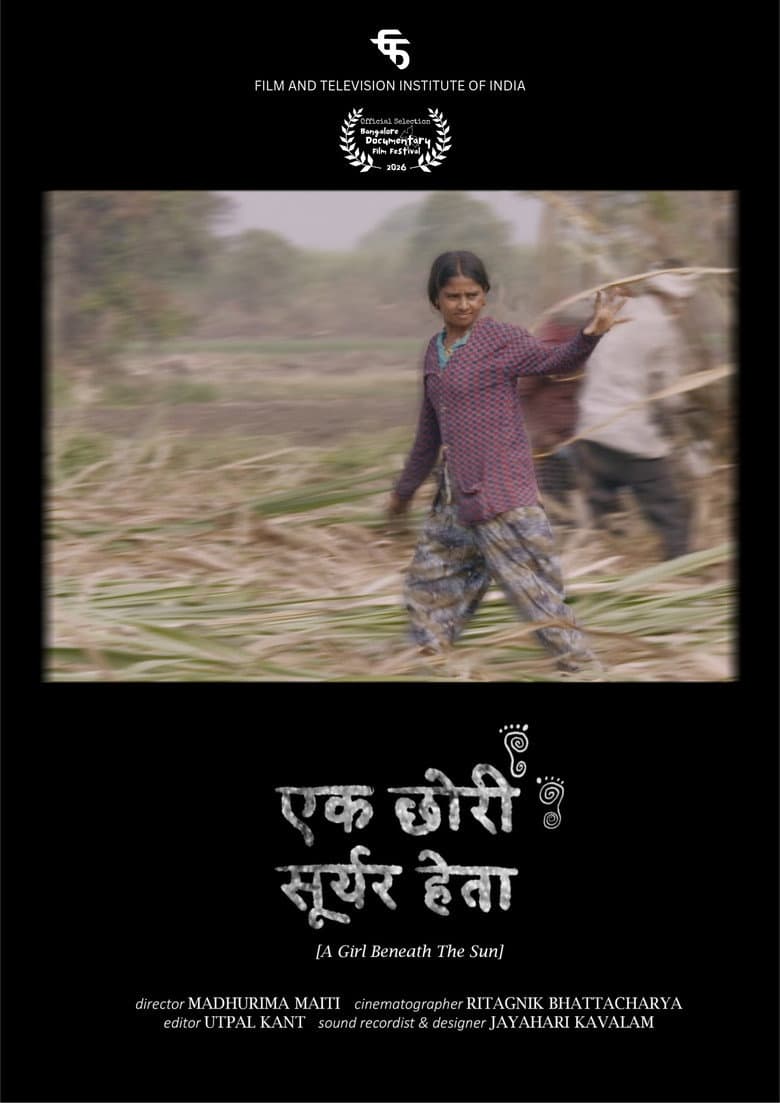
There is a moment early in Madhurima Maiti’s new documentary where the camera simply holds on a field of tall sugarcane. The stalks sway, indifferent, while somewhere beyond them a young woman is quietly rearranging the entire architecture of her life. That tension - between the immovable world and the person trying to find a way through it - is the pulse of The Girl Beneath The Sun, a twenty-minute film that has been gathering quiet attention since its release on November 6.
At the centre of the film is Shivkanya, a teenage sugarcane harvester whose days are measured in rows cut and bundles hauled. Maiti’s camera follows her into the fields and back into the cramped domestic spaces where another kind of labour awaits. Shivkanya is a new mother, a new wife, and still, in many ways, a girl herself. The film observes her confronting early motherhood and marriage not as abstract concepts but as daily, physical realities: the weight of an infant on her hip, the unspoken duties that pile up faster than she can name them, the eccentric husband whose behaviour she navigates with a patience that seems both learned and enforced.
What distinguishes the film is its refusal to editorialise. Maiti, working in Hindi, trains her lens on the ordinary textures of Shivkanya’s world - the steam rising off a cooking pot, the calloused hands, the long walk between home and field - and lets the accumulation of those images do the arguing. There is no narrator instructing us how to feel. There is only Shivkanya, moving through a future that appears to have been decided for her long before she had a chance to weigh in.
The title itself carries a gentle irony. Beneath the sun, in the punishing heat of the harvest, Shivkanya is both defined and obscured. Her dreams, her identity, her hopes for her child and for herself - these are the things the film circles around, sometimes glimpsed, sometimes swallowed whole by circumstance. Maiti finds her subject in moments of stillness as much as motion, and in doing so captures something that statistics about child marriage or agricultural labour cannot: the interior life of a young woman who is expected to have no interior life at all.
At just twenty minutes, the film operates with a restraint that feels deliberate. There is no sweeping score, no dramatic reenactment, no talking heads explaining the broader context. This is observational documentary in its purest form, and it trusts the audience to sit with what they are seeing. The casting is listed as unknown, and that anonymity is part of the point - Shivkanya is specific and singular, but she is also every girl in every field whose story goes unrecorded. The film gives her a face without turning her into a symbol, which is a harder balance to strike than it sounds.
It is worth noting that the film arrives with no rating on TMDb as of this writing, a reflection less of its quality than of its scale. This is a small documentary from a director who is not yet a household name, released without fanfare into a marketplace that rarely makes room for twenty-minute films about teenage mothers in sugarcane fields. And yet the conversations it has started suggest something else: that there is an audience, however modest, hungry for stories that resist simplification.
Maiti’s achievement is one of perspective. She does not look down at Shivkanya, nor does she romanticise her. The camera stays at eye level, patient and curious, and in doing so extends a kind of dignity that the world around Shivkanya routinely withholds. The girl beneath the sun is not asking to be rescued. She is asking, perhaps, to be seen. And for twenty minutes, she is.
The Girl Beneath The Sun is currently streaming. A full review will follow separately.