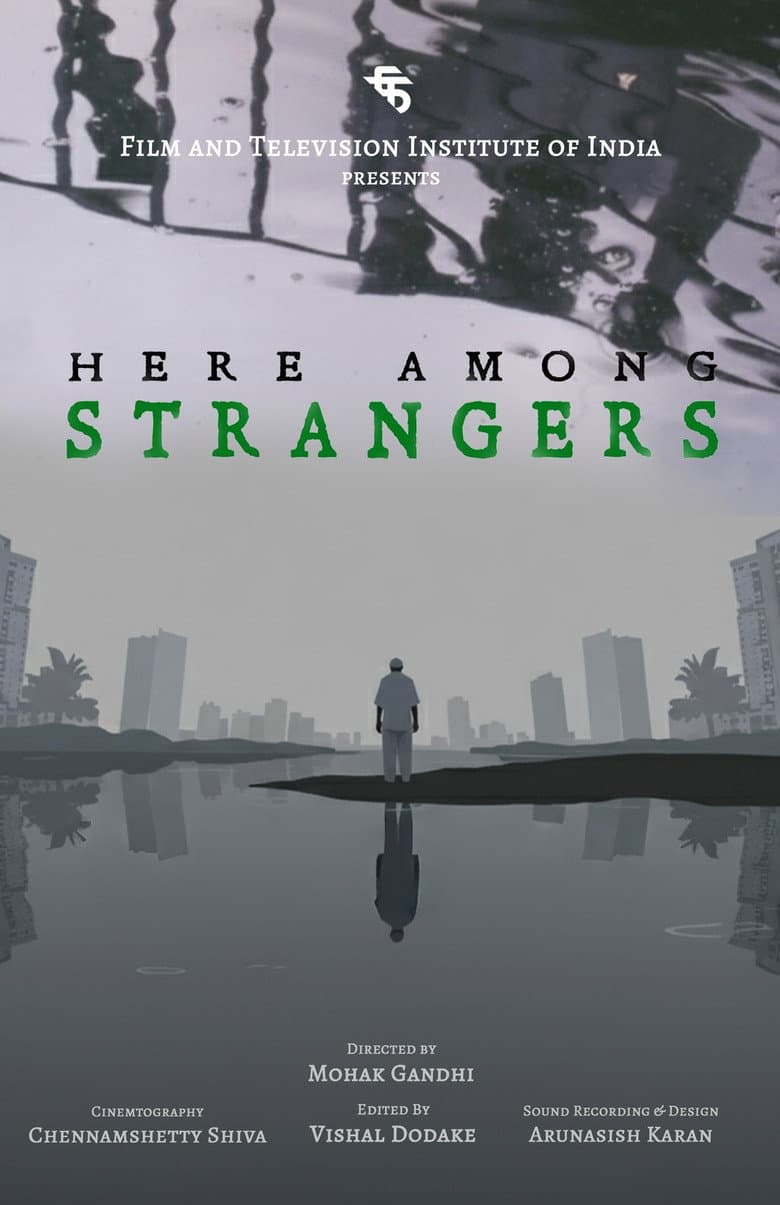
The city does not notice him, and that is rather the point. In Mohak Gandhi's quietly devastating short film "Here Among Strangers," seventy-year-old farmer Sudhakar Bhujbal tends his shrinking patch of land while glass towers climb into the sky around him, their reflections slicing across the soil he has worked his entire life. The film, which released on November 17, runs just thirteen minutes, but it carries the weight of an entire vanishing world.
Gandhi, directing in Hindi for Bollywood, has crafted something that feels less like a narrative and more like an act of witnessing. The premise is deceptively simple: a farmer, a field, and a city that is rapidly forgetting both. But within that simplicity lies a sharp meditation on displacement, invisibility, and the strange arithmetic of progress, the kind that adds skyscrapers while subtracting the people who made the ground mean something.
Sudhakar is not a revolutionary. He does not shout at bulldozers or chain himself to gates. He simply continues, morning after morning, doing what he has always done. And that continuation, in Gandhi's hands, becomes its own form of defiance. The character belongs to a lineage of Hindi cinema's great witnesses, the stubborn, unglamorous figures who refuse to move, not out of heroism but because the land is who they are. The film understands that the most radical act in a city obsessed with the new is sometimes the refusal to abandon the old.
What strikes you about the premise is its familiarity. Every Indian metropolis carries its own version of Sudhakar somewhere at its edges, a figure glimpsed briefly from a moving car, tending a field in the shadow of a mall, the sort of sight that registers for a second and then dissolves. Gandhi's achievement is holding the camera steady on the person the skyline has rendered invisible, refusing the usual cinematic temptation to make him picturesque. He is not a symbol first and a man second. He is a farmer with an acre or two left, and the film treats his stubbornness with the seriousness it deserves.
At thirteen minutes, "Here Among Strangers" operates in a compressed register that suits its subject. There is no room for subplots or backstory dumps; the film moves with the rhythm of its protagonist's days, patient and deliberate, and the brevity itself feels intentional, as though the story knows it exists on borrowed time. The runtime is an argument, not a limitation. Short films in Bollywood rarely get this kind of considered attention, and it is worth noting that the format allows Gandhi to avoid the melodrama that a feature-length treatment might have demanded. No villainous builder, no climactic confrontation, no swelling music to tell us how to feel.
The film's title is doing heavy lifting. "Among strangers" cuts two ways: the city sees Sudhakar as a stranger in its midst, an inconvenient remnant of a past it would rather pave over. But the phrase also carries his own experience, the quiet alienation of living on land you know deeply while the world around it becomes unrecognizable. The soil is familiar. Everything above it is not.
Hindi cinema has a long history of rural stories, but this is something different. This is a rural story with the city already arrived, the transformation no longer pending but complete, with one old man left standing in its wake. Gandhi isn't mourning a past that can be restored. He's documenting a present that most people have already agreed to look past. There's a bracing honesty in that approach, and it makes the film feel less nostalgic than clear-eyed.
The release arrives at a moment when conversations about urban development, land rights, and who gets to remain in a changing city are as urgent as ever. "Here Among Strangers" doesn't lecture. It doesn't point fingers. It simply places a old man in a field and holds him there for thirteen minutes, asking you to look when the city won't. Not every story needs to shout to be heard. Some, like this one, just keep tending the earth and wait for the world to notice.